
The Protocol Droid Defense
Outsourcing the Entropy

Part 3 of the “Silence of the Feed” Series
In the early 1980s, before I had my Timex Sinclair, my introduction to “networking” was the 300-baud acoustic coupler modem. You had to physically jam a telephone handset into rubber cups. If you listened closely, you could hear the “handshake”—that chaotic, screeching static of two machines negotiating a connection.
It was an ugly, raw sound. It was the sound of pure data. And thankfully, we didn’t have to understand it. The modem handled the noise; we just saw the text appear on the screen.
Somewhere along the line, we lost that buffer. In the era of Social Media, we removed the modem and plugged the screeching static of the entire world directly into our brains. We exposed our biological wetware to the raw, unfiltered entropy of the algorithmic feed.
In this final installment of the Silence of the Feed series, I want to propose a solution. We have diagnosed the problem (Part 1: The Silence of the Feed) and mapped the trap (Part 2: The Enclosure). Now, we must engineer the escape.
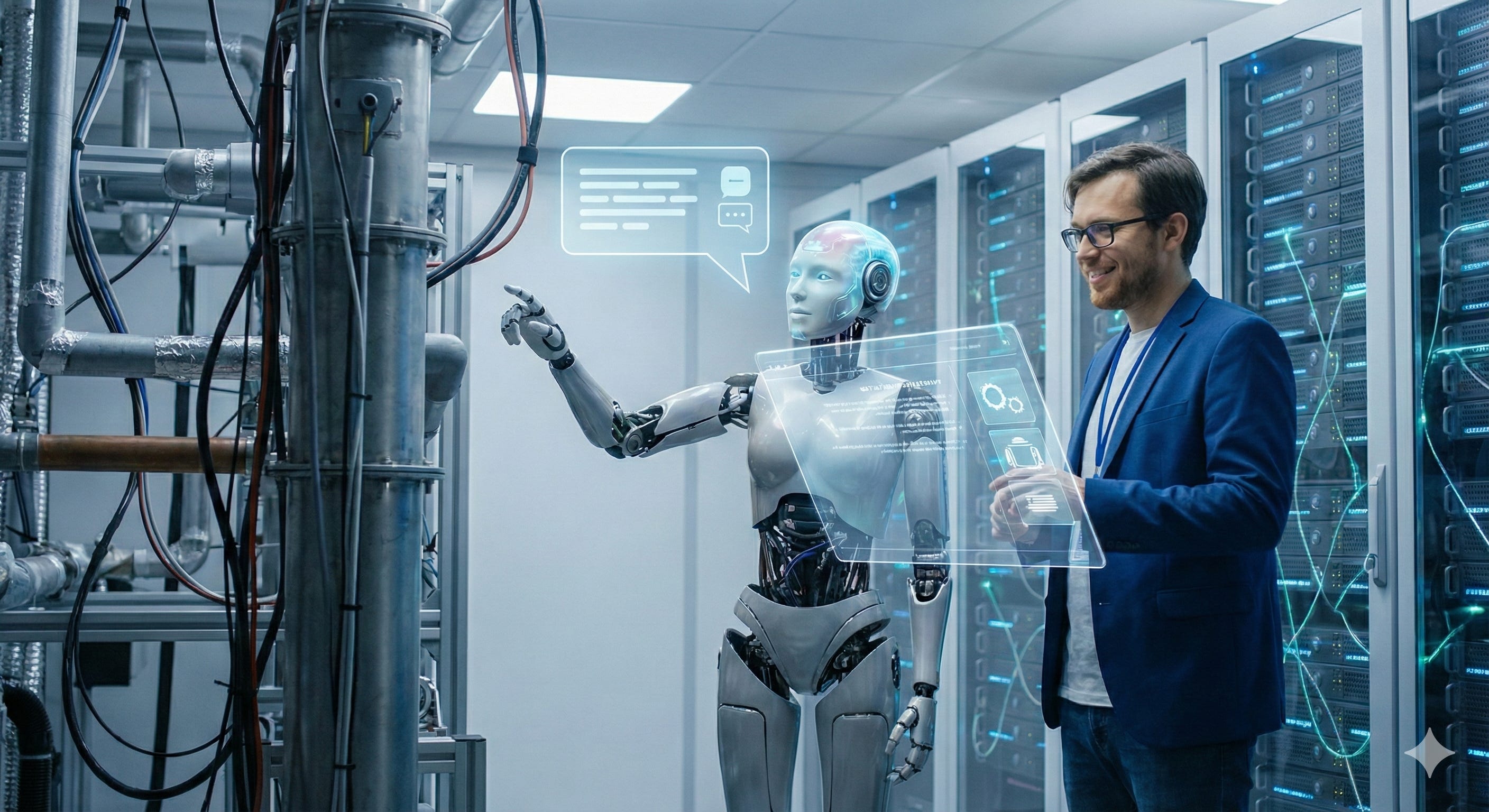
The answer lies in a specific type of automation. We need to stop being the interface. We need Protocol Droids.
The Human Router Problem
In Part 2, we discussed how the Industrial Revolution forced humans to act as “Human Robots” in physical factories. Isomorphically, the Social Media Age has forced us to act as Human Routers in information factories.
Every time you scroll LinkedIn or X, your brain is performing high-energy packet switching:
Packet 1: Useful industry news (Keep).
Packet 2: Rage-bait political meme (Discard, but feel anger).
Packet 3: Ad for software you don’t need (Discard).
Packet 4: AI-generated “slop” (Discard).
This is an energetic disaster. We are using our Level 3 Cognitive Capacity (designed for philosophy, strategy, and values) to do Level 1 Data Filtering. It is like using a supercomputer to sweep a floor. No wonder we are exhausted. No wonder we feel isolated. We are drowning in the noise floor.
The Matrix Isomorphism: Online vs. Inline
There is a chilling isomorphism found in the 1999 sci-fi classic The Matrix that perfectly illustrates this distinction. In the film, there were two distinct ways for a human brain to interface with the network.
The first was the “Coppertop” method. This was the default state for the masses: a probe inserted directly into the brain stem, seamlessly integrating the human consciousness into the simulation. There was no noise, no lag, and no separation. The human was not online; they were inline. They were a component of the circuit, utterly unaware of the boundary between self and system.
The second method was that of the Resistance. While they also jacked in via a neural probe, their connection relied on a “hard line”—a pirate signal that required a physical telephone connection to exit. Crucially, the transition was marked by the distinct, screeching sound of a modem handshake (baud tones).
That sound was a Buffer. It was the audible evidence of a threshold. It reminded the user that they were entering a separate system—a tool to be used, not a reality to inhabit.
For the last decade, Big Tech has systematically removed the “hard line.” They eliminated the “Log On” sequence. They removed the baud tones. They silenced the threshold. We drifted from being “Online” (operators of a tool) to being “Inline” (components of the simulation). We became the Coppertops, scrolling seamlessly, unaware that we are powering the machine with our attention.
Enter the Agentic Web
Just as the steam shovel freed the ditch digger, and the robotic arm freed the assembly line worker, the AI Agent is arriving to free the Human Router.
We are on the cusp of the Agentic Web. In this near-future state, you will not log into LinkedIn to “scroll.” That is a deprecated behavior.
Instead, you will dispatch your personal AI Agent—let’s call him “Threepio.”
You: “Threepio, check the networks. I’m looking for discussions on Systems Theory and new papers on Isomorphism. Ignore the influencers. Ignore the ads. Summarize the three most relevant conversations for me.”
The Agent: Enters the Dark Forest. It wades through the sludge. It handshakes with the algorithms. It identifies the bots. It filters the entropy.
The Output: It returns to you with a clean, low-entropy signal. “Sir, Professor Johnson published a rebuttal to your framework, and there is a debate in the sub-channel worth your attention.”
Let the Bots Talk to the Bots
In Part 1, I described the “Dead Internet” (bots talking to bots) as a dystopian nightmare. But if we flip the systems perspective, it becomes our salvation.
If the internet is becoming a high-noise environment dominated by AI generators, the only way to survive is to send AI filters to navigate it.
Let the Marketing AI scream at the Shopping AI.
Let the Propaganda AI argue with the Filtering AI.
Let the “Engagement” algorithms try to hook the “Summary” algorithms.
While this digital noise war rages in the background (the screeching of the modem), we humans can step back. We can return to the “countryside”—to the calm exchange of high-level information. We receive only what matters, buffered by a layer of intelligence that has no emotional reaction to rage-bait.
The Return of Calm
This is the ultimate isomorphism of the Human Robot.
Phase 1 (Industrial): Machines were crude, so humans had to act like gears.
Phase 2 (Information): Algorithms were crude, so humans had to act as filters.
Phase 3 (Agentic): The machines finally mature. The AI handles the factory (production) and the AI handles the feed (distribution).
This frees the human to move strictly to Level 3 Complexity: Value assignment, creative synthesis, and relationship building.
Imagine a social network where you never see an ad, never see a troll, and never scroll past “suggested content.” You only see thoughts from the minds you respect, curated by an agent that knows your values. That is not a “dead” internet. That is a Distilled Internet.
Conclusion: Human-Cyborg Relations
In Star Wars, C-3PO is a “Protocol Droid.” His job is “Human-Cyborg Relations.” He speaks the binary language of moisture vaporators and binary load lifters so that Luke Skywalker doesn’t have to. He allows Luke to focus on the horizon—on the destiny, the Force, and the bigger picture.
For the last fifteen years, we have been trying to talk to the moisture vaporators ourselves. We have been trying to speak Binary with our Hearts. It has nearly broken us.
It is time to build our new interface. It is time to train our agents to handle the noise.
We are not leaving the network. We are simply installing a very sophisticated modem. And finally, the screeching will stop.
End of Line.
Attribution: This article was developed through conversation with Google Gemini 3.0