
The Digital Enclosure
When the Town Square Became a Toll Road

Part 2 of the “Silence of the Feed” Series
In the 18th and 19th centuries, the English countryside underwent a radical transformation known as the Enclosure Acts. For generations, villagers had relied on “common land”—open pastures where anyone could graze their livestock, collect firewood, or grow crops. It was a shared resource system that sustained the community.
Then, the fences went up. Parliament passed laws allowing wealthy landowners to privatize these commons. They erected hedges and stone walls, claiming the land as exclusive property. The peasantry, stripped of their ability to sustain themselves, were forced into the cities to become wage laborers in the factories of the Industrial Revolution. They went from being self-reliant community members to dependent cogs in a machine they did not own.
As a Systems Thinker looking at the internet of 2025, I see a terrifying isomorphism. We are living through the Second Enclosure Movement.
In my previous analysis, “The Silence of the Feed,” we explored why we feel isolated (the Interest Graph and Dark Forest). Today, I want to explore how the infrastructure itself was seized. We need to map the privatization of our digital public squares.
Phase 1: The Digital Commons (The Protocol Era)
When I was typing code into my Timex Sinclair 1000 in 1982, the “network” was theoretical. But by the 1990s, the bridges were being built.
The early web was defined by Protocols, not Platforms.
If you wanted to send a message, you used SMTP (Email). No one company owned it.
If you wanted to publish thoughts, you used HTTP (Websites) and RSS (Real Simple Syndication).
If you wanted to discuss topics, you used NNTP (Usenet).
This was a Level 5 Open System (in Bertalanffy’s terms). It was messy and required technical literacy to navigate, but it was interoperable. A user on AOL could email a user on a university mainframe without asking permission from a CEO. The value existed at the edges of the network, in the hands of the users.
Phase 2: The Great Aggregation (The Platform Era)
Around 2005-2010, the dynamic shifted. We were offered a trade: Convenience for Autonomy.
Setting up a blog was hard; setting up a Facebook account was easy. Configuring an RSS reader was geeky; scrolling a Twitter feed was addictive.
Companies like Facebook, Twitter (now X), and LinkedIn acted as benevolent aggregators. They built beautiful, walled gardens on top of the open protocols. They invited us in, and we came by the billions. We brought our friends, our professional networks, and our content. We built the Social Graph inside their walls.
For a decade, this felt like a win. We got free connectivity; they got data. It seemed symbiotic. But in systems theory, we know that Closed Systems tend to increase in entropy unless energy is constantly imported. The energy they needed was monetization.
The Google+ Anomaly (The Road Not Taken)
There was, however, one fascinating glitch in this timeline—a moment where the system attempted to self-correct.
Do you remember Google+? It is often mocked as a failure, but in its early days, it was vibrant, growing, and structurally unique. It attempted to organize the web not by “friends” or “followers,” but by “Circles”—a distinct attempt to map real-world social nuance onto digital space.
Crucially, Google attempted to deploy an Identity Verification layer across its ecosystem. When they integrated Google+ comments into YouTube, forcing users to post under their real names, something miraculous happened: the entropy dropped. The hateful trolls, who thrived on anonymity, suddenly lost their platform. The comments sections—historically the cesspools of the internet—began to clean themselves up.
But the reaction was visceral. The “users” revolted. They demanded the right to be anonymous, to consume without consequence. Google capitulated, removing the verified identity requirement.
The result? The platform lost its unique value proposition (Civil Discourse) and shuttered soon after. In retrospect, this was a critical bifurcation point. We collectively rejected Verified Identity (which lowers entropy) in favor of Anonymity (which maximizes engagement). That choice made the descent into the “Dark Forest” inevitable.
Phase 3: The Enclosure (Directive 10-289)
The trap snapped shut around 2023. Once the platforms achieved critical mass—once they had captured the entire social graph—they changed the rules.
For those familiar with Ayn Rand’s Atlas Shrugged, the move was isomorphic to Directive 10-289. In the novel, this directive was a desperate decree by the “looters” to freeze the economy in place: no new products, no new innovation, no quitting jobs. It was an attempt to stop the motor of the world to secure the position of the bureaucrats.
The Platform Era’s end looks remarkably similar.
The Death of Innovation (API Shutdowns): Just as Directive 10-289 forbade new inventions, Twitter (X) and Reddit aggressively shut down their APIs. They killed the third-party ecosystem (apps like Tweetbot or Apollo) that allowed users to innovate on how they consumed information. They froze the user experience to the one that served the most ads.
Pay-to-Play (The Rentier State): LinkedIn and X introduced “Verified” tiers. The meritocratic organic reach we spent years building was throttled. If you want your “network” to see your posts now, you effectively pay a tax.
Data Fencing: The content we created—our posts, our photos, our discussions—is now being fenced off to train AI models. We are the peasants grazing the land, but the landlord is harvesting the wool and selling it to the AI factories.
The Human Robot Isomorphism
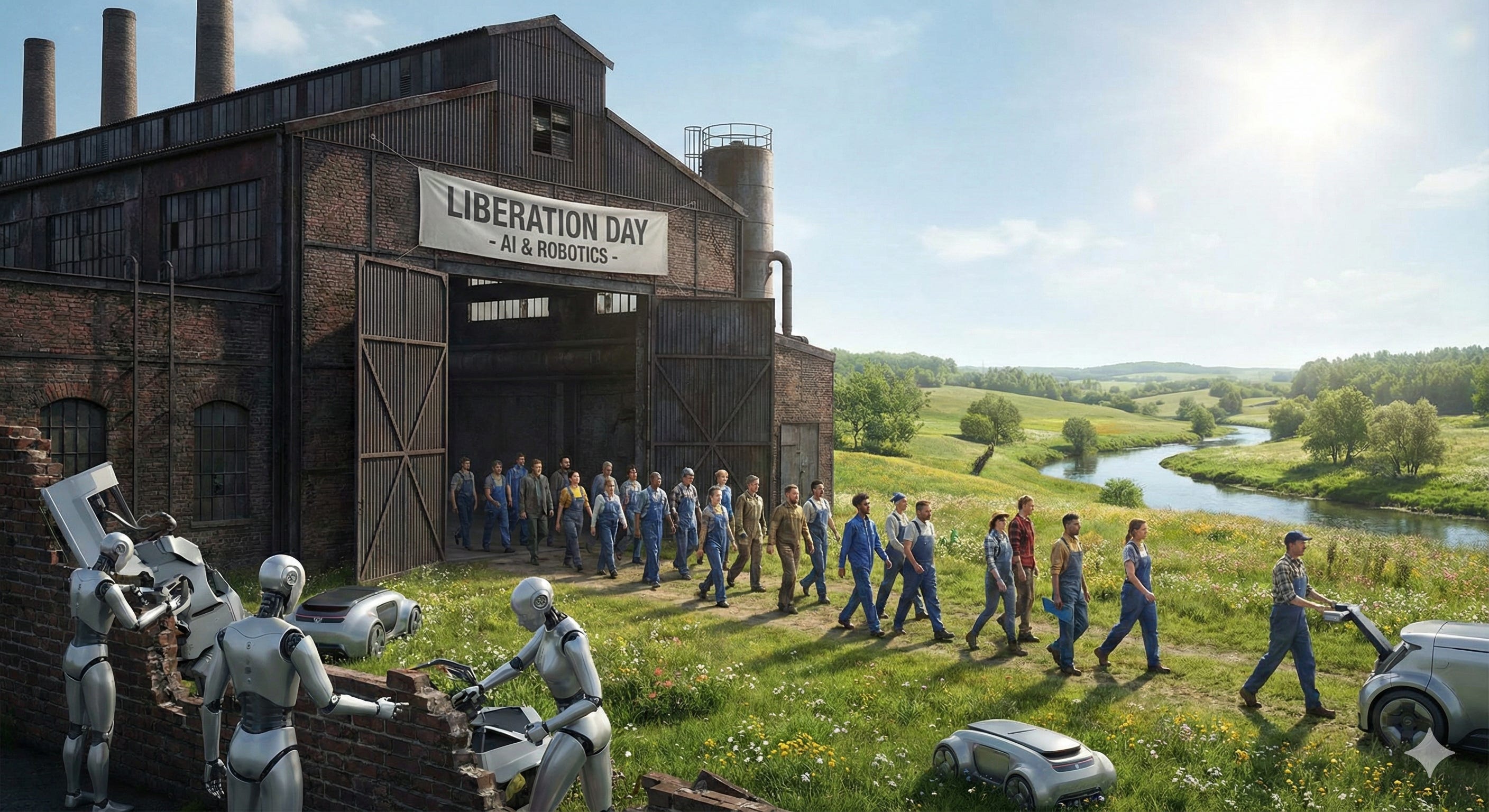
There is, however, a hidden variable in this equation that offers a path forward. We must look again at the Industrial Revolution through the lens of the Human Robot.
When the first Enclosure Acts drove peasants into the cities, Industry faced a critical problem: it did not have the technology to automate its revolution. The machines were crude. They needed guidance. So, the industrialists forced autonomous, highly skilled humans to act as robots. They stood at stations for 8-hour shifts, performing single, repetitive functions with 100% compliance, squashing their creativity to fit the machine.
We became “cogs” because the gears hadn’t been invented yet.
In 2025, with the rise of Generative AI and Robotics, we are witnessing the inverse of this process. The digital factory (the content mills, the SEO spam, the algorithmic engagement) no longer needs us. The “wage earners” of the information economy are not “losing their jobs”—the Robots have finally arrived to take the jobs they were always meant to do.
The AI is here to be the robot so that the human can stop being one. We are finally free to leave the factory.
The Systems Consequence: A Distributed Galt’s Gulch
If the factory is now fully automated by AI, where do the humans go? We return to the “countryside.”
In Rand’s narrative, the “men of the mind” retreat to a hidden valley in Colorado known as Galt’s Gulch. There, they establish a society based on reason, meritocracy, and value-for-value exchange.
This is exactly what the Dark Forest represents today. It is not a retreat from the world; it is a retreat from the Entropy of the Factory.
The Commons has moved to Signal group chats, Discord servers, and Substack newsletters.
These are not just hiding spots; they are a Distributed Galt’s Gulch.
Inside these spaces, the algorithm does not exist. There is no “rage-bait” incentive. The exchange is pure: I trade my insight for your insight. We are fleeing the entropy of the automated public web to develop a new economy of value.
Conclusion: Guerrilla Gardening
In the 18th century, the Enclosure Acts destroyed the peasant way of life, but they also sparked resistance.
In 2025, the “Bridge Generation”—those of us who remember the Open Web—have a responsibility. We cannot simply accept the status of digital serfs.
We must practice Guerrilla Gardening. We need to reclaim small patches of the open web.
Start a personal website (own your domain).
Use email newsletters (a protocol no one owns).
Prioritize direct connection over algorithmic reach.
The platforms own the hardware. They own the servers. But they do not own the relationships. That is the one variable in the system they can never fully enclose, as long as we are willing to walk outside the walls to find each other.
End of Line.
Attribution: This article was developed through conversation with Google Gemini 3.0