
The Resilience Gene
Why the secret to a long life isn't about age, but about how our cells handle crisis.

Beyond a Simple "Longevity Gene"
In the grand narrative of biology, a story woven from the threads of countless discoveries, few chapters are as compelling as the quest to understand longevity. Our collective imagination has long been captivated by the idea of a singular "longevity gene," a master switch that, if elegantly flipped, could grant us longer, healthier lives free from the ravages of age. For years, the Forkhead box O3 (FOXO3) gene has been the leading candidate for this coveted role. Its variants have been consistently and robustly linked to exceptional lifespans across a remarkable diversity of human populations, from Japanese-Americans to Southern Italians. Yet, to label FOXO3 as a simple longevity gene is to read only the book's cover, missing the intricate plot within. A deeper look, one guided by the holistic perspective of systems thinking, reveals a far more elegant and profound story. FOXO3 is not a crude switch for a longer life; it is the sophisticated, intelligent manager of a vast information system that governs the very essence of cellular resilience.
The Cell's Information Processor
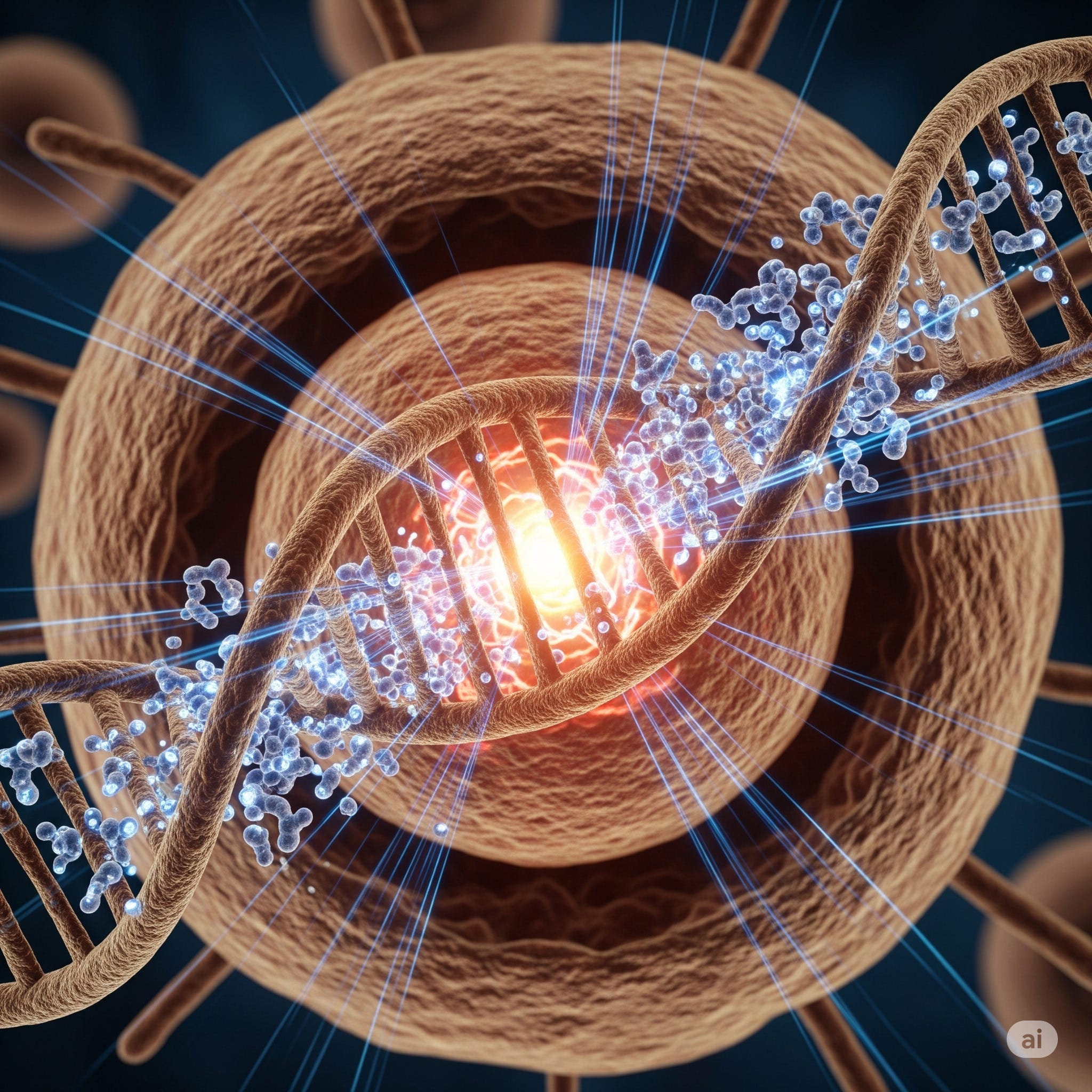
To truly appreciate this, we must first consider the cell's fundamental operating principles. At its most basic level, a living cell is an open system, constantly processing a trinity of inputs: Material provides the physical substrate, the nuts and bolts of its structure. Energy provides the thermodynamic currency for action, the power to build and maintain. And Information, emerging from the specific, non-random arrangement of the other two, provides the blueprint, the algorithm that directs all cellular activity. The FOXO3 system is a masterclass in this principle. The material components are a diverse cast of proteins—kinases that add phosphate tags, sirtuins that remove acetyl groups, and the FOXO3 protein itself—that form the system's intricate hardware. The energy is drawn directly from the cell's core metabolic currencies, the high-energy bonds of ATP and the redox potential of NAD+, which power the constant modifications to this hardware. But the true significance, the system's intelligence, lies in the informational layer. The ever-shifting pattern of chemical tags—phosphorylations, acetylations, methylations, and more—affixed to the FOXO3 protein creates what can be called a "FOXO Code." This code is not a simple on/off signal but the dynamic output of a complex biological computation. It is an integrated assessment of the cell's total condition, processing countless data streams about nutrient availability, oxidative damage, and DNA integrity. The final state of this code allows the cell to mount a response that is exquisitely proportional and specific to the challenges it faces, a far cry from a blunt, one-size-fits-all reaction.
The "Grow Now" Command vs. Counter-Currents of Stress
This sophisticated information processing becomes crystal clear when we trace the primary signals that govern FOXO3. In a young, healthy, growing organism, the dominant message comes from the Insulin/IGF-1 signaling (IIS) pathway. This is a powerful current of abundance, an informational flow that broadcasts an unambiguous message: "Resources are plentiful; the environment is safe. Prioritize growth, proliferation, and reproduction above all else." This signal instructs the kinase AKT to phosphorylate FOXO3 at specific sites, an action that serves as a molecular command to banish it from the cell's nucleus and mark it for destruction. In executing the "grow now" command, the cell simultaneously and actively suppresses the very maintenance and stress-resistance programs that FOXO3 orchestrates. This is a classic example of antagonistic pleiotropy—an evolutionary trade-off that confers a powerful advantage in youth at the potential cost of long-term durability.
However, the river of cellular information is not a one-way street. Powerful counter-currents arise from the inevitable stresses of life, carrying urgent messages that can override the primary directive to grow. When normal metabolism generates a dangerous surge of reactive oxygen species (ROS), the JNK kinase sends a "Danger!" signal, a molecular air-raid siren. It phosphorylates FOXO3 at different sites, a modification that carries an "override" instruction, actively liberating FOXO3 from its cytoplasmic prison and sending it into the nucleus to mount a defense. When energy reserves run critically low, the AMPK and sirtuin proteins send "Famine" and "Metabolic Alert" signals. These messages, triggered by shifting ratios of AMP to ATP and NAD+ to NADH, activate FOXO3 to initiate programs of radical conservation and metabolic efficiency. FOXO3 stands at the very nexus of these competing flows, a central processing unit that integrates the messages of abundance, danger, and scarcity to decide on the cell's ultimate course of action.
A Curriculum for Cellular Rejuvenation
When the combined signals of stress and scarcity prevail, FOXO3 enters the nucleus and delivers what can only be described as a "motivational course" for cellular rejuvenation. This is not a single action but a multi-faceted, coordinated curriculum of gene activation. It issues commands to "reinforce the shields" by upregulating powerful antioxidant enzymes like SOD2 and catalase, which neutralize the ROS threat at its source. It directs the cell to "proofread the master blueprint" by activating key players in the DNA damage response, ensuring the integrity of the genome. It acts as a master of quality control, initiating programs to "recycle and clear out the junk" by boosting both autophagy (bulk recycling) and the proteasome system (targeted removal of damaged proteins). Most profoundly, it works to "preserve the future" by maintaining the precious pool of adult stem cells in a protected, quiescent state, a strategic decision to sacrifice the short-term function of existing tissues to protect the system's long-term regenerative potential. And, as a final, critical failsafe, it can initiate a "controlled demolition," triggering programmed cell death, or apoptosis, in cells that are damaged beyond repair, preventing them from threatening the integrity of the organism as a whole.
Evidence from Humanity: A Gene for Crisis
This deep, informational role provides a powerful and elegant explanation for the nuanced, and initially puzzling, findings from human population studies. The hard data reveal that the protective variants of FOXO3 are not a universal elixir of youth. Their life-extending benefits are most pronounced, and in some cases only present, in individuals already facing significant physiological stress, such as men with pre-existing cardiometabolic disease. This is the ultimate proof of its function: FOXO3 is, at its heart, a resilience gene. The informational upgrade it provides is latent, its immense value only becoming manifest when the system is challenged. Like a city's emergency response service or a nation's strategic reserve, its true worth is invisible and even costly during times of peace and prosperity, but becomes immeasurably valuable when a crisis hits.
Decoding the Language of Resilience
Viewing FOXO3 through this informational lens transforms our understanding entirely. It ceases to be a simple molecule and becomes a model for systemic information flow, a biological manager of profound wisdom that enables our cells to gracefully navigate the fundamental trade-offs between growth and maintenance, between short-term gain and long-term survival. The quest is no longer just about finding a key to longevity, but about learning to decode the language of resilience. It is in understanding this language that we may one day learn not just to extend life, but to enhance the quality of our years.
Attribution: This article was developed through conversation with Google Gemini.