
The Reality Toolkit
Why the Scientific Method is Your Best Defense in a World of Noise

The signal is getting harder to find. We're adrift in a sea of information, where the currents of misinformation and the deliberate tides of disinformation threaten to pull us under. In this chaotic digital ocean, intuition is a leaky raft and common sense is a faulty compass. The 'post-truth' era isn't a future dystopia; it's our daily reality, a landscape where our own cognitive biases are exploited and the very foundations of shared knowledge feel unstable.
This isn't mere hyperbole; it's a diagnosis of our modern condition. The architecture of our digital world, optimized for engagement over accuracy, has supercharged the spread of falsehoods. We must distinguish between misinformation—false claims spread without malicious intent, like a well-meaning relative sharing a bunk health tip—and disinformation, the deliberate, weaponized creation of falsehoods to achieve a political or financial goal. Both pollute the well of public knowledge, but the latter poisons it. This environment preys on our innate mental shortcuts, the very cognitive biases that helped our ancestors survive on the savanna but fail us spectacularly in the information age. Confirmation bias whispers sweet nothings in our ear, urging us to embrace data that fits our existing beliefs. The Dunning-Kruger effect gives the loudest voices an unearned confidence. In this storm, we need more than a better map; we need to learn how to navigate.
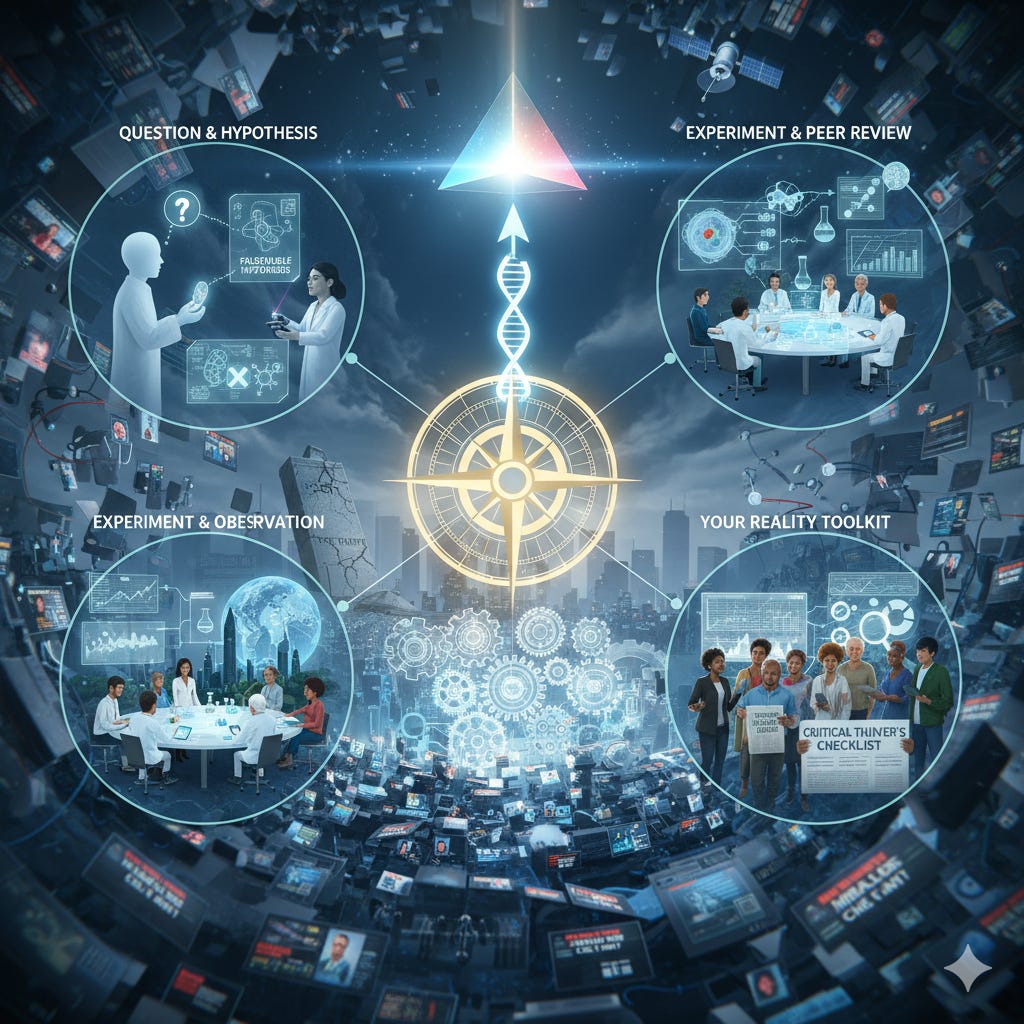
A Compass in the Chaos
How do we anchor ourselves to reality when the ground is constantly shifting? The answer doesn't lie in a new app or a political ideology. It lies in a 400-year-old framework, a rigorous yet elegant process that is less a rigid set of rules and more a mindset—a reality toolkit. I'm talking about the scientific method, and it is no longer the exclusive domain of researchers in lab coats. Forged in the intellectual fires of the Enlightenment by thinkers like Francis Bacon and Isaac Newton, it has become an essential civic skill, a necessary instrument for clear thinking and the most robust defense we have against the noise. It is, at its core, a formalized system of skepticism.
The Courage to Be Wrong
At its heart, the scientific method is a commitment to intellectual honesty. It begins with a simple, powerful act: observing the world and asking "Why?" From there, it guides us to form a hypothesis—not a wild guess, but an educated, testable explanation. "The Wi-Fi is slow because too many people are streaming" is a perfectly valid hypothesis. It's grounded in prior knowledge and, crucially, it's testable.
This brings us to the philosophical core of the method: falsifiability. Championed by the philosopher of science Karl Popper in the 20th century, this principle is the sharp line dividing science from pseudoscience. It demands that for any claim to be scientific, there must be a way to prove it wrong. Consider the claim, "All swans are white." This is a strong scientific statement because it is eminently falsifiable; you only need to find one black swan to disprove it. The search for that black swan is what drives the science forward.
In contrast, an unfalsifiable claim, like "This company's success is due to its ineffable corporate spirit," is a dead end. There is no conceivable evidence that could disprove it. Popper used this razor to critique fields like astrology. A horoscope's prediction that "a surprise is in your future" is so vague it can never be proven wrong. It's a statement designed to be confirmed. Falsifiability forces our ideas out of this comfortable fog and into the harsh light of reality. It risks being wrong, and in that risk lies its power. It is the ultimate antidote to confirmation bias because it forces the investigator to actively search for contradictory evidence, not just supporting examples.
Isolating the Signal
Once we have a falsifiable hypothesis, we must gather evidence. The gold standard is the controlled experiment, a powerful tool for isolating cause and effect. The beauty of an experiment lies in its ability to untangle the knotted mess of correlation and causation. We see correlations everywhere—ice cream sales rise at the same time as drowning incidents. But a controlled experiment could reveal the hidden "confounding variable"—in this case, summer heat—that is driving both. By systematically changing one independent variable (the thing you are testing, like a new fertilizer) and measuring the effect on a dependent variable (the outcome, like crop yield), while keeping everything else the same (the control group), we can make powerful inferences about what is actually causing the change.
However, we cannot always run an experiment. It would be unethical to test the link between smoking and cancer by forcing people to smoke. In these cases, meticulous observational studies become our lens. Epidemiologists like Richard Doll and Austin Bradford Hill did just this in the 1950s. Through massive, long-term studies comparing the health outcomes of smokers and non-smokers, they built an unassailable statistical case against tobacco, decades before the precise biological mechanisms were fully understood. Their work, like that of John Snow tracing cholera to a London water pump a century earlier, shows that we can find the signal in the noise even without a pristine laboratory.
Whether through experiment or observation, the goal is to collect objective data. But data alone is inert. The next step is analysis—interrogating the results with an open and skeptical mind. This is where a null result, finding no effect, is just as valuable as a positive one. It tells us a hypothesis is wrong, allowing us to eliminate a possibility and refine our next question. Science progresses by pruning the branches of failed ideas. A conclusion, therefore, is not a proclamation of absolute truth, but a humble statement of what the evidence supports, complete with an honest accounting of the study's limitations and the statistical probability that the result was due to chance.
Truth Through Scrutiny
Yet, the scientific method’s true genius lies in its communal nature. It’s a social process, an ecosystem of ideas designed to filter out individual bias. After a scientist draws a conclusion, their work faces the crucible of peer review. Here, other anonymous experts in the field scrutinize the methodology, the analysis, and the conclusions, looking for flaws the original authors may have missed. It's not a perfect system—it can be slow, and biases can still creep in—but it is a critical filter that catches a vast amount of shoddy work before it ever sees the light of day.
Even then, the ultimate test is replication. Can another independent researcher in another lab follow the same steps and get the same result? In recent years, some fields, like social psychology, have faced a "replication crisis," where foundational studies have failed to be reproduced. To outsiders, this may look like a failure of science. In reality, it is the immune system of science working perfectly. It's a painful but necessary process of self-correction. This self-correcting ecosystem of institutionalized skepticism is what allows a reliable consensus to emerge from the messy, human process of discovery. It’s a system of feedback loops, constantly testing its own conclusions.
The Engine of Modernity
This is not an abstract exercise. This toolkit built our modern world. The symbiotic dance between science and technology—whereby scientific discoveries fuel new tech, and new tech allows for new discoveries—is responsible for nearly every advancement we take for granted. Consider the device you are reading this on. Its existence is a direct result of physicists in the early 20th century exploring the bizarre quantum world of the atom. Their purely theoretical work on semiconductors led directly to the invention of the transistor, the foundational component of all modern electronics.
Or consider our food. The Green Revolution of the mid-20th century, led by agronomist Norman Borlaug, used the scientific method—systematic hypothesis testing, cross-breeding, and controlled field trials—to develop high-yield, disease-resistant crops. His work is credited with saving over a billion people from starvation. The staggering increase in human lifespan is a testament to scientific medicine, which dragged healing from the realm of superstition and bloodletting into the evidence-based world of germ theory, vaccines, and randomized controlled trials—the latter being a perfect application of the controlled experiment to human health. This toolkit works.
Wielding Your Own Toolkit
So how do we apply this formidable toolkit in our own lives? By cultivating a mindset of inquiry. When faced with a headline, a tweet, or a political promise, we must become active investigators, not passive recipients. We can use a simple mental checklist.
Let's apply it to a common online claim: "A new supplement made from Arctic berries instantly boosts your immune system."
Who is the source? Is it a peer-reviewed journal or a company selling the supplement? Is the "doctor" cited a medical researcher or a chiropractor with an online storefront? Assess expertise and conflicts of interest.
What is the claim? What does "boosts your immune system" even mean? This is a vague, unfalsifiable claim. A scientific claim would be more specific: "reduces the duration of the common cold by 10%."
What is the evidence? Is it a personal anecdote ("I felt better in a day!") or a link to a randomized, double-blind, placebo-controlled trial? Demand the highest quality of evidence for the claim being made.
Is there an alternative explanation? Could the person's cold have simply run its natural course? Could it be the placebo effect, a powerful and well-documented phenomenon?
This internal checklist transforms us from passive consumers into critical thinkers. It slows us down, forcing a pause between information and belief. It encourages us to be comfortable with nuance and uncertainty, and to be willing—even eager—to change our minds in the face of new, compelling evidence. This is the very definition of intellectual growth.
In an age defined by the struggle between signal and noise, the scientific method is not just for scientists. It is a universal framework for understanding. It is our shared inheritance, a powerful toolkit for deciphering reality, and our most reliable guide for navigating the turbulent waters ahead. It is, ultimately, an act of optimism—a belief that by observing carefully, thinking critically, and being honest about what we find, we can get closer to the truth.
Attribution: This article was developed through conversation with Google Gemini.
Hi William, This is a great article, I agree whole heartedly. I've been working on a CustomGPT (TruthForge v0.3) that helps users with implementing reflection on claims, or their own beliefs. It's available on one of the tabs at TheQuietMission.org. I'd love to get your feedback on how it works.
I'm working on a v0.4 currently, and will be ready to share access with that later this week if you're intersted.
Great article and very true. We need more people approaching reality like this.