
The Nine-Month Miracle
Saving SWIFT and the Dawn of AI-Accelerated Space Servicing

For twenty-two years, the Neil Gehrels Swift Observatory has stood as humanity’s premier cosmic sentinel, pivoting its optical, ultraviolet, and X-ray eyes toward “things that go boom in the night.” Launched in November 2004, Swift revolutionized high-energy astrophysics by capturing gamma-ray bursts (GRBs)—the fleeting, cataclysmic deaths of massive stars and the violent mergers of neutron stars. It was Swift that provided the definitive observational evidence that the heavy elements in our universe, such as gold and platinum, are forged in the crucible of these extreme cosmic collisions.
But in late 2024, a silent threat emerged from our own star. As Solar Cycle 25 reached a highly active solar maximum, intense space weather bombarded Earth’s upper atmosphere. The influx of extreme ultraviolet radiation and high-energy particles heated and swelled the thermosphere, expanding the atmospheric boundary outward.
For Swift, flying at what was once a near-vacuum altitude of 370 miles (roughly 600 kilometers), the consequence was immediate and severe: an exponential increase in aerodynamic molecular drag. Lacking onboard propulsion to raise its orbit, the 1.5-ton observatory began a rapid, terminal descent. By mid-2025, predictive models warned that the spacecraft would descend below the critical threshold of 186 miles (300 km) by October 2026, leading to a destructive, fiery re-entry.
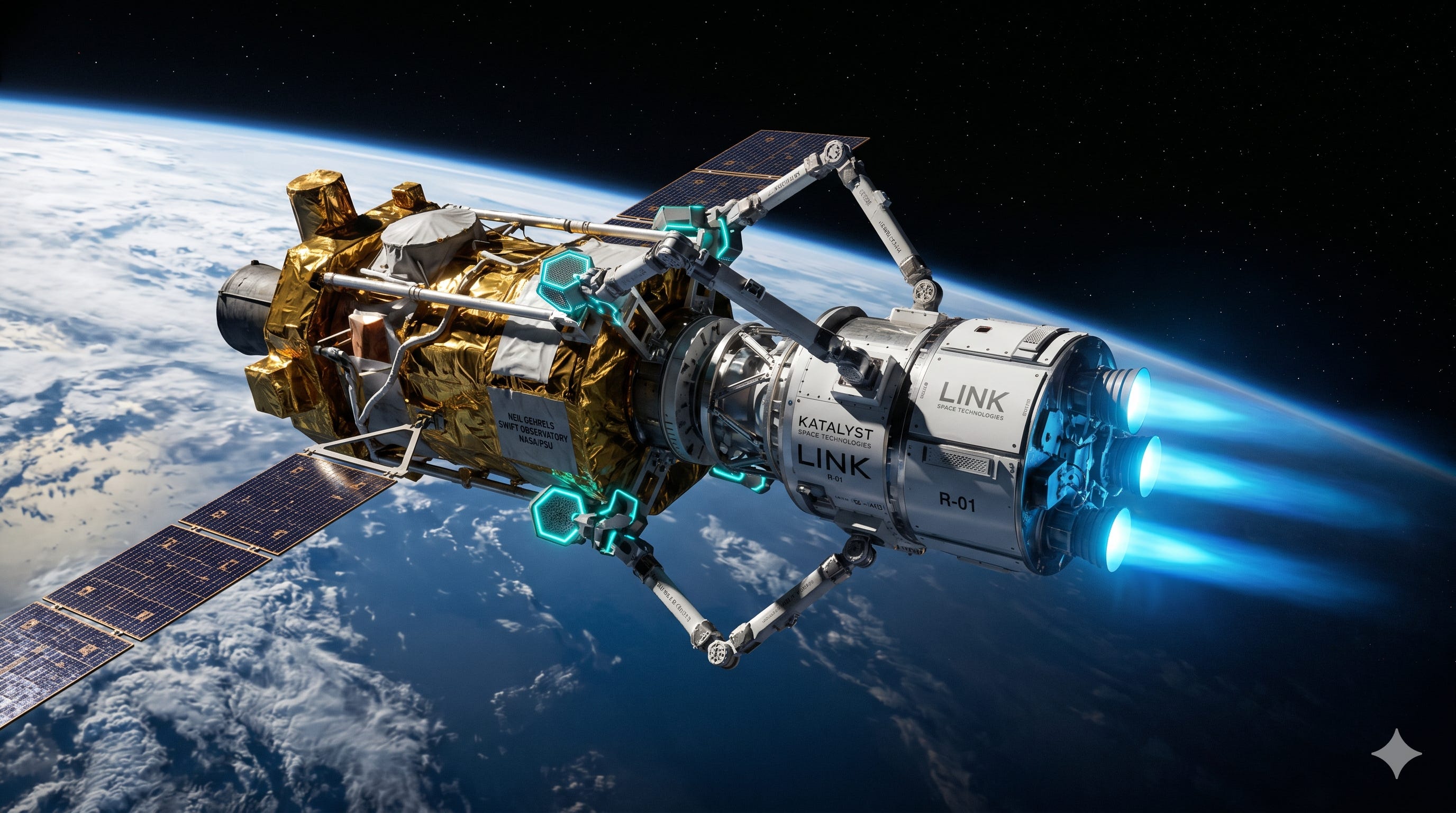
In response, NASA turned to an unconventional ally. In September 2025, the agency awarded a $30 million contract to Katalyst Space Technologies, a small aerospace startup, to execute a daring, unprecedented rescue. The mission: design, build, test, and launch a robotic servicing spacecraft called LINK to capture and boost Swift back to a stable 373-mile (600 km) orbit.
The timeline given to Katalyst was just nine months. In the traditional aerospace sector, where mission lifecycles are measured in decades and budgets in billions, a nine-month development cycle is not just fast—it is theoretically impossible. Yet, as the Pegasus XL air-launched rocket prepares to take flight from Kwajalein Atoll, the LINK spacecraft sits ready in the fairing.
How did we get here? The answer lies at the intersection of rapid human operational pivot and the explosive integration of advanced digital engineering, synthetic modeling, and AI-driven design tools.
The Technical Crucible: Capturing the Uncooperative
To appreciate the scale of this achievement, one must understand the absolute physical and computational complexity of the rendezvous and proximity operations (RPO) required to save Swift.
Swift was never designed to be serviced. It possesses:
No standardized docking rings.
No magnetic capture fixtures.
No cooperative optical or radio navigation beacons.
No detailed CAD models of its aft-end (as Katalyst CEO Ghonhee Lee noted, “Nobody took a picture of the backside of Swift before it launched”).
To capture this silent, fast-moving target at an orbital velocity of approximately 17,000 mph (27,000 km/h), the LINK spacecraft must execute an entirely autonomous sequence. Real-time radio latencies between Earth and the spacecraft make manual joystick piloting impossible.
LINK must utilize its onboard LiDAR sensors and optical cameras to scan Swift’s structure as it approaches. Onboard edge computers must instantly process these point clouds, matching the raw, noisy geometric data against historical construction layouts to identify the ground-handling fixtures—metal brackets used exclusively for crane-hoisting Swift on Earth prior to its 2004 launch.
Once these brackets are localized, LINK must coordinate three robotic arms with localized LiDAR-equipped grippers to close the distance, matching the rotational dynamics of the telescope, and securely grapple the target without imparting destabilizing torques that could send both spacecraft into an uncontrollable spin.
How AI Tools Compressed Years Into Months
To design, simulate, and manufacture a 400 kg spacecraft capable of this autonomous feat in under a year, Katalyst and its partners had to abandon legacy engineering pipelines in favor of an AI-augmented methodology.
1. Structural Generative Design
The design of the structural interfaces for LINK’s three robotic arms required an exceptional strength-to-weight ratio to survive both the launch environment of the Pegasus XL and the operational loads during orbital boosting.
Instead of traditional, manual drafting-and-stress-analysis cycles, engineers deployed generative design algorithms. By defining load vectors, forbidden volumes, and manufacturing constraints (specifically optimized for rapid CNC milling and 3D printing of titanium), the AI iterated through thousands of stress-optimized structural geometries in a matter of hours. The resulting bio-mimetic bracket shapes were lighter, stiffer, and ready for fabrication weeks ahead of schedule.
2. High-Fidelity Digital Twins and GNC Auto-Coding
The Guidance, Navigation, and Control (GNC) flight software is the brain of the mission. Traditional software verification requires years of hardware-in-the-loop (HWIL) testing.
Katalyst circumvented this by creating an end-to-end “Digital Twin” of both LINK and Swift within a simulated space environment. Leveraging machine learning models, the simulation ran millions of distinct docking trajectories, introducing random variables such as sensor noise, sudden solar flares, actuator latencies, and variations in atmospheric density.
AI-driven auto-coding suites translated these validated simulation algorithms directly into flight-ready C++ code. The system auto-generated unit tests and verified edge cases that human developers might have overlooked, transforming software synthesis from an bottleneck into an accelerator.
3. Rapid COTS Optimization and System Modeling
LINK relies heavily on Commercial Off-The-Shelf (COTS) subsystems, such as its xenon-fueled Hall-effect thrusters and modular avionics. The challenge with COTS in aerospace is integration—making sure disparate systems from different manufacturers do not interfere with each other thermally, electromagnetically, or structurally.
Using multi-domain system modeling software running automated compatibility algorithms, Katalyst could predict system-wide thermal dissipation profiles and electrical transients before the physical hardware was assembled. This digital validation ensured that when the physical components arrived at NASA Goddard for vibration and thermal vacuum (TVAC) testing, they passed on the first run.
The Human Factor: The Drag-Reduction Campaign
While AI and automated pipelines accelerated the hardware delivery, human operational agility was required to buy the critical time needed to make the launch window.
In December 2025, the Swift flight operations team at Pennsylvania State University executed an aggressive drag-reduction campaign. Recognizing that every centimeter of surface area exposed to the oncoming molecular flow accelerated Swift’s orbital decay, they completely altered the telescope’s observation strategy.
By replacing approximately 25% of its scientific targets, they pointed Swift in a streamlined, aerodynamic orientation that minimized its cross-sectional area. In April 2026, they took the difficult step of turning off the Burst Alert Telescope (BAT) and the Ultraviolet/Optical Telescope to conserve power, allowing them to feather the spacecraft’s massive solar arrays edge-on to the velocity vector.
This brilliant engineering pivot slowed the orbital decay, extending Swift’s survival margin above the critical 186-mile mark from June to September 2026. It was this extra margin that allowed Katalyst’s LINK to complete its integration and securely mount to the Pegasus XL rocket.
Pedagogical Imperative: Shifting STEM Education for the AI Era
The success of the Swift rescue mission sends a clear signal to academia: the profile of the successful engineer has fundamentally changed. For decades, STEM undergraduate curricula have focused heavily on teaching students to manually execute highly localized calculations—deriving differential equations, hand-calculating finite element stress tensors, or writing low-level boilerplates for microcontrollers. While a foundational understanding of physics and mathematics remains non-negotiable, the primary bottleneck in modern engineering is no longer calculation, but orchestration and systems thinking.
To prepare the next generation of engineers to save future assets or construct the infrastructure of tomorrow, STEM education must adapt in several key ways:
From Synthesizer to Systems Architect: Students must be taught how to leverage generative AI design tools and automated coding suites. The modern engineer’s role is to define the boundary conditions, state the optimization goals, and then critically evaluate and validate the AI’s output.
Rigorous Validation and Verification (V&V): Because AI can hallucinate software logic or produce structurally unfeasible designs if given incorrect parameters, curriculum focus must shift toward validation. Knowing how to test, how to design robust validation suites, and how to spot systemic anomalies in simulated models is now a primary survival skill for engineers.
Interdisciplinary Systems Modeling: Space systems are a complex web of thermodynamics, orbital mechanics, structural dynamics, and electrical networks. Universities must move away from siloed department projects and embrace collaborative, multi-domain system design platforms that utilize AI to model complex, real-world dependencies.
A New Era of Public Good
The rescue of the Neil Gehrels Swift Observatory is more than a triumph of robotic spaceflight; it is a demonstration of how rapid, AI-accelerated engineering serves the public good.
For a fraction of the cost of building and launching a new $500 million space telescope, a private startup—empowered by advanced software tools and agile methodologies—is poised to extend the life of a priceless scientific instrument for another decade. This “Uber Eats” model of on-demand orbital servicing, as Katalyst CEO Ghonhee Lee calls it, promises to dramatically reduce space debris, protect critical global infrastructure, and ensure that humanity’s windows to the universe remain open.
As LINK awaits its launch in the Pacific, it carries with it not just the hopes of astrophysicists worldwide, but the blueprint for a faster, smarter, and infinitely more adaptable engineering future.
Attribution: This article was developed through conversation with Google Gemini 3.5 Flash