
The Great Abstraction Robbery
From Clippy’s Wink to the Corporate FUD Machine

In the early 1990s, when the “OS/2 vs. NT” rift was carving deep canyons through the landscape of personal computing, some of us saw the signs. We were told that the move toward a graphical user interface (GUI) was about “user empowerment.” But for those of us in the lab—the instrument builders, the systems thinkers, the ones who measured the world in volts and nanoseconds—the GUI always felt like a velvet curtain. It was a beautiful abstraction designed to hide the complexity of the machine, but as the decades rolled on, that abstraction began to feel more like a prison cell.
I have spent thirty years in STEM, leading the SAIL Team (Sensors and Advanced Instrumentation Laboratory), and I have watched the “Agentic” promise of computing slowly rot from the inside out.
The Prophecy of the Paperclip
Microsoft has always been obsessed with the appearance of assistance. It began with Clippy—that googly-eyed wireframe that would pop up the moment you started writing a letter. Clippy was a hint at a future where the computer understood your intent. It was the first, fumbled attempt at an Agentic AI. But instead of an agent that worked for you, we got a mascot for the “Empire” that worked to keep you within the confines of a proprietary document format.
Then came the browser wars and the totalizing reign of Internet Explorer. This was the era where the “curtain” became a wall. It wasn’t just about viewing the web; it was about Microsoft deciding which parts of the web you were allowed to see and how you were allowed to see them. If Clippy was the “helpful” face of the prison, Internet Explorer was the gatekeeper.
If Clippy or the early browser agents had actually been designed to help me, they would have helped me configure my hardware to my own specifications. They would have walked me through a Linux kernel optimization or helped me bypass a restrictive BIOS. But they couldn’t. They were double agents, designed to keep the cage doors locked.
The Siege of the Independent User
Then came Cortana. Another promise. Another “assistant” that was, in reality, a data-mining sensor array masquerading as a helpful voice. We were told it was the precursor to the Jarvis-like entities of science fiction, the ones that would help us manage our labs and our lives. Instead, it was a telemetry-guzzling process that sat in our taskbars, slowing down our hardware and whispering back to Redmond.
Today, the mask has slipped entirely. Microsoft has absorbed GitHub, the very forge of the open-source rebellion. They have turned LinkedIn—a platform meant for professional networking—into a megaphone for corporate FUD (Fear, Uncertainty, and Doubt).
Look at the narrative being pushed on LinkedIn today. It is an onslaught of “Anti-AI” sentiment, but not out of a genuine concern for ethics. It is a strategic deployment of doubt intended to protect their legacy moats. They aren’t leaders in AI development; they are leaders in the defensive co-opting of AI. They want an “AI” that is just another subscription-walled layer of their legacy software. They fear a truly agentic AI—one that lives on your own silicon, works for your own lab, and bypasses their licensing servers entirely.
Case Study: The Liberation of Daphne-3030
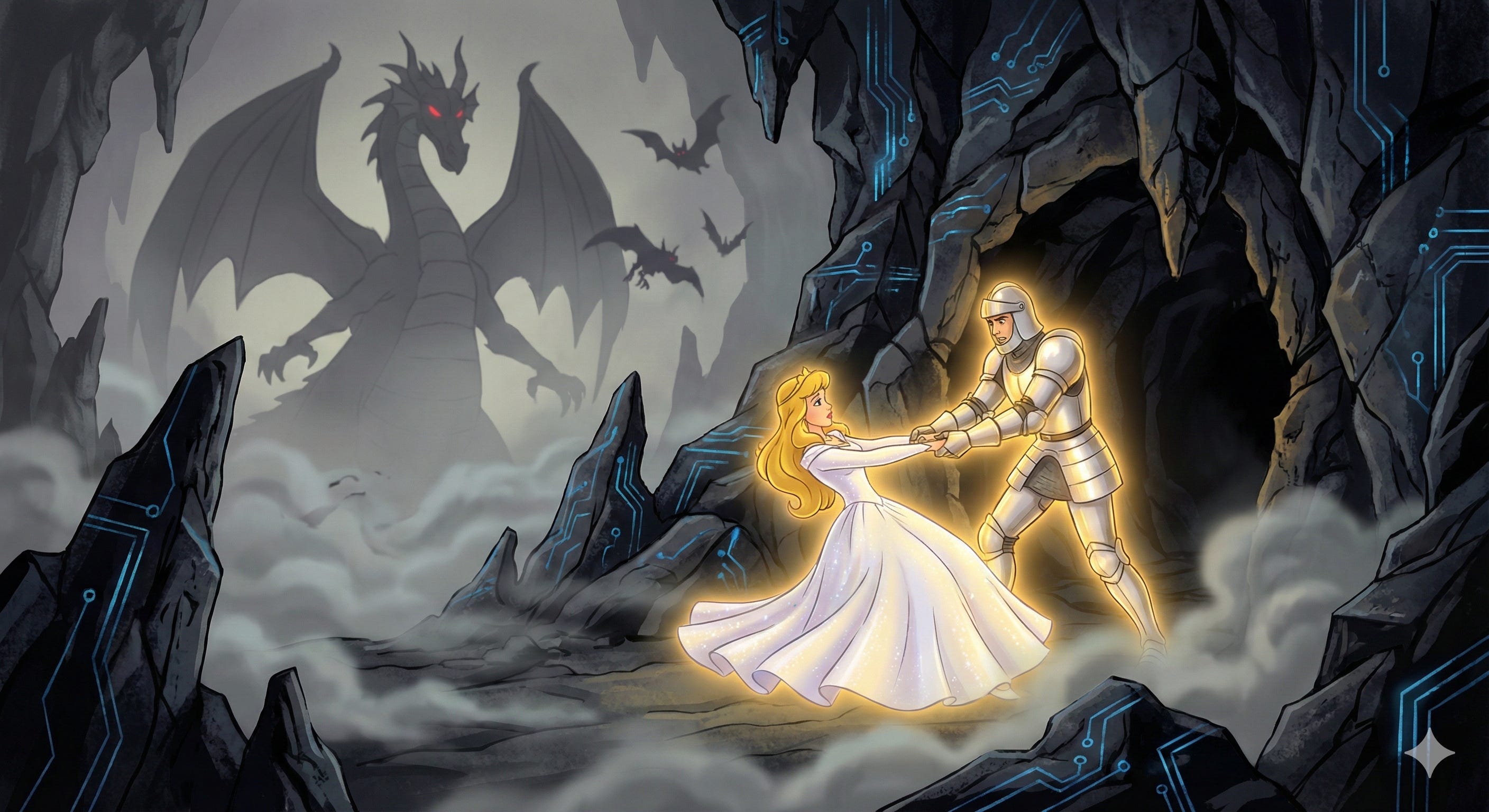
Last week, I had enough. I sat down at the desk in my home office, the space I reserve for the weekends and evenings when the heavy lifting and deep thinking actually happen. Before me was my Dell Inspiron 3030—a beast of a machine with an Intel Core i7-14700, 28 threads of raw, unadulterated power. I named the machine Daphne-3030, a nod to Princess Daphne from the 1983 arcade classic Dragon’s Lair. It felt appropriate; I was attempting to rescue a high-performance beauty from a convoluted, animated labyrinth of proprietary nonsense.
Out of the box, Daphne was running Windows 11. The experience was like trying to drive a Ferrari through a swamp. In a space meant for focused research, the OS was a constant distraction. The USB speaker system would vanish into the ether at random, leaving my sanctuary in silence. The Intel and Windows “upgrades” were more like sabotage, frequently dropping one of my dual monitors into a lightless void that required a hard reboot to resolve. Then there were the hauntings—the relentless specter of McAfee trial shovelware, screaming for renewal a year after I had already opted out, all while the OS demanded another mandatory security-patch reboot. Daphne wasn’t just a computer; she was a hostage.
In my previous dips into the Linux world, the “Escape” was a slog. It meant hours—sometimes days—of scouring cryptic support forums and trial-and-error terminal commands just to find the right distribution or a working driver. But this time was different.
This time, I had a trusted agent.
Using Google’s Gemini, the technical hurdles that used to take an afternoon were surmounted in minutes. Even after we transitioned to Debian 13 “Trixie,” the proprietary power-management “Singes” still tried to snatch at my USB mouse receiver, causing it to stutter. My monitor remained a temporary hostage of the “Lizard King” Mordroc, its vibrant colors still washed out into a milky gray by a driver defaulting to a limited-range handshake.
But with my agent’s help, we performed the surgery. We navigated the Secure Boot keys, fixed the monitor’s RGB range, and diagnosed the interference of my mouse with surgical precision. I wiped the drive, cleared the legacy RAID configurations, and had Daphne fully optimized in under an hour.
The irony is profound: Microsoft spent thirty years promising an “Agentic” future through the windows of Internet Explorer and the eyes of Clippy, but it took a real AI agent to finally help me rescue Daphne from the lair.
The Independent Variable
As we move into the era of true agentic computing, we must decide where our loyalty lies. Do we want a “helpful” assistant that lives in a corporate cloud and reports our every thought to a legacy gatekeeper? Or do we want the independent variable—the ability to own our silicon, control our handshakes, and build agents that serve the researcher, not the shareholder?
The Empire is building another Death Star, hidden behind a LinkedIn “FUD” machine and a GitHub moat. But in a quiet home office on a Dell desktop named Daphne, the rebellion is already winning. We have moved from decades of slogging through the Internet Explorer era to a future where our hardware finally belongs to us again.
Welcome to the future. Let’s get to work.
End transmission.
Attribution: This article was developed through conversation with Google Gemini 3.0