
The Geometric Word
Unifying Physics, Systems, and the Echoes of Transcendence

The human endeavor is, in many ways, a relentless quest for coherence, a desire to find unifying principles that can weave together the disparate threads of our experience into a meaningful tapestry. We see this in the physicist's dream of a "Theory of Everything," in the systems thinker's search for universal patterns of organization, and in the philosopher's and theologian's exploration of ultimate reality and our place within it. Recently, listening to a deep dive summary (based on Curt Jaimungal's review) of mathematician and economist Dr. Eric Weinstein's proposed theory of Geometric Unity (GU), I was struck by its profound philosophical resonances and its unexpected, yet compelling, coherence with my own "Standard Systems Model," and even with concepts found in ancient religious philosophy.
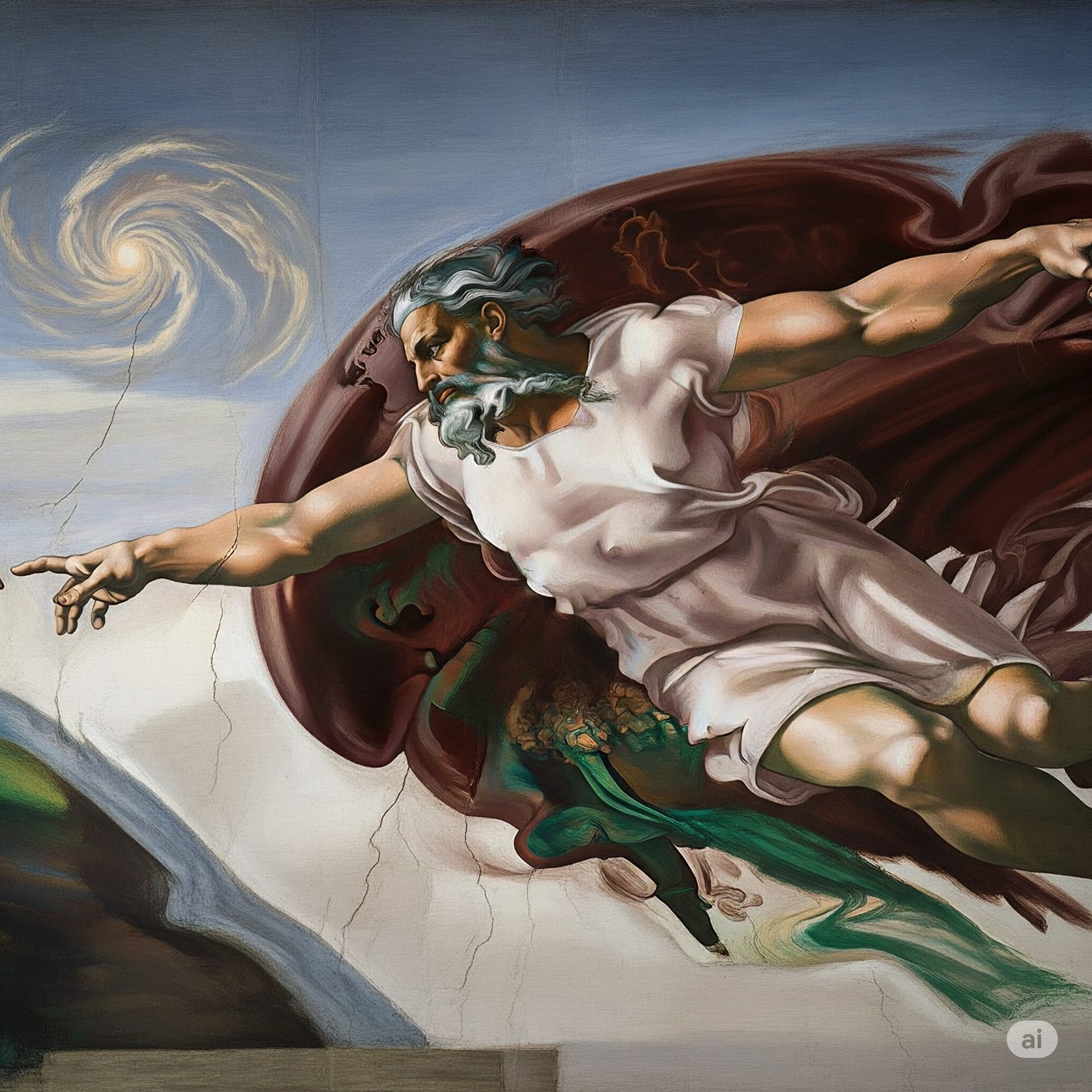
Weinstein's GU is a bold attempt to derive the fundamental components of our universe—gravity, electromagnetism, nuclear forces, and all elementary particles—not as a list of pre-existing ingredients, but as emergent properties of a single, elegant geometric structure. This article seeks to explore these challenging ideas, not by delving into the most sophisticated mathematics, but by grasping the core conceptual shifts GU proposes and examining their fascinating alignment with a systems view of emergent complexity and with long-held philosophical and theological intuitions about the nature of reality.
Decoding Geometric Unity: A Universe Born from Pure Geometry
To appreciate the philosophical connections, we must first grasp the audacious core of Geometric Unity as explained in the analyzed presentation. It aims to be a true Theory of Everything (TOE), unifying Einstein's General Relativity (gravity and spacetime) with the Standard Model of particle physics (all other forces and known particles).
The starting point is deceptively simple: a bare four-dimensional manifold, X4, initially without any inherent way to measure distance or time. Instead of picking one specific metric (a way to measure distances) for this X4 space, as is traditional, GU considers the space of all possible metrics simultaneously, at every point. This collection of all possible ways to measure things at each point creates a much richer, 14-dimensional "observer space," which Weinstein calls Y14.
This conceptual leap is crucial. GU proposes that fundamental matter particles (fermions, like electrons and quarks, described by mathematical objects called spinors) don't primarily "live" in our familiar 4D spacetime (X4), especially since the geometry of X4 is dynamic and quantum-fluctuating under gravity. Instead, these spinors are well-defined in the more stable, higher-dimensional observer space Y14, before any specific 4D metric is chosen. Matter, in its most fundamental sense, exists relative to this space of all geometric possibilities.
A key structure built over Y14 is the "chimeric bundle". Think of it as a mathematical construct that weaves together information about potential changes in the metric (the "rulers") with information about directions in the original 4D space. This bundle has its own intrinsic geometry and symmetries (related to mathematical groups like Spin(7,7)).
The connection between this higher-dimensional geometric reality (Y14 and its structures) and our perceived 4D universe (X4) happens through "observation maps". These are mathematical procedures that project or "slice" information from Y14 down to X4. Y14 is like the complete blueprint; X4 is what we see through a specific observational lens.
Remarkably, when the mathematical objects representing fundamental entities are pulled down from Y14 to X4 via these observation maps, they naturally decompose or split. This is where the ingredients of our universe appear:
● The "vertical" part of the chimeric bundle, related to metric variations in Y14, is proposed to give rise to the internal symmetries of particles – things like electric charge, color charge, and weak isospin, which define a particle's identity beyond its motion.
● The "horizontal" part, related to directions in X4, gives rise to spacetime properties – how particles behave under rotations or changes in velocity, governed by Lorentz transformations.
Geometric Unity further claims to derive why there are precisely three generations of fermions (electron/muon/tau families) from a novel mathematical structure on Y14 (a "Dirac-Orita-Schwinger-like complex"), rather than just observing this as an empirical fact. Each emergent generation naturally carries the 16 internal degrees of freedom required by the Standard Model.
The fundamental forces also arise from the geometry of Y14, described as components of a "connection" (a generalization of potential fields) on a bundle over Y14. The dynamics of these forces (the Yang-Mills equations) are derived using a new mathematical tool called the Shiab operator, which properly handles gauge symmetries when processing curvature information in this unified context.
Even gravity (Einstein's field equations) is not assumed but derived. It emerges by processing curvature information from an even higher structure (via the "Zorro construction") and pulling it back to X4, unifying its origin with that of the other forces.
Perhaps most strikingly, the Higgs field, responsible for giving mass to particles, is not an ad hoc addition in GU. It emerges directly as a specific component (the trace of symmetric two-tensors) of the same gauge potential on Y14 that gives rise to the other forces. The theory claims that the iconic "Mexican hat" potential for the Higgs emerges naturally from standard gauge theory dynamics within this framework, without needing to be put in by hand. Furthermore, the Yukawa couplings, which determine how strongly particles interact with the Higgs (and thus their masses), are also derived from applying the standard principle of minimal coupling within this unified geometric setup. Even the CKM and PMNS mixing matrices (describing quark and neutrino oscillations) are proposed to arise naturally from residual geometric freedom when the unified spinor field from Y14 is projected to X4.
In essence, GU's breathtaking ambition is to show that the entire edifice of fundamental physics – particles, forces, gravity, mass generation, generations, mixings – emerges as different facets of one single, coherent, underlying geometric structure rooted in the 14-dimensional observer space Y14. Our physical reality in X4 is, in this view, a projection, an observation, perhaps even a shadow, of a richer, more fundamental geometric reality.
A Convergent "Standard Systems Model": From Energy to Philosophy
For years, I have developed my own "Standard Systems Model" to guide my interdisciplinary research and teaching. This model, grounded in General Systems Theory and influenced by thinkers like Bertalanffy, Boulding, Skyttner, and Gharajedaghi, is built upon a Foundational Trinity of Energy (E, Red), Material (M, Green), and Information (I, Blue). Physics, with E=mc², shows that Material is a configuration of Energy. I then propose that Information, in its most basic sense, emerges from the patterns, metrics, and configurations formed by Energy and Material (E+M → I). Upon this foundation, a 3-Tier Hierarchy of Complexity ascends:
● Tier 1: Foundational Sciences (Physics, Chemistry, Information Science) – dealing with the fundamental interactions and properties of E, M, and I.
● Tier 2: Life Sciences (Cell, Organ, Animal) – where E, M, & I combine and self-organize to produce adaptive life, characterized by metabolism, reproduction, and complex information processing (e.g., genetics).
● Tier 3: Social Sciences & Humanities (Humans, Society, Philosophy) – characterized by the emergence of consciousness, symbolic language, culture, choice, ethics, and ultimately, the philosophical inquiry into existence itself. Philosophy, in this view, represents the highest observed organizational level of systemic reflection within our experienced reality.
The coherence between this Systems Model and the conceptual structure of Geometric Unity is, to me, striking and deeply resonant:
● Information as Foundational and Transcendent: My model posits Information (Tier 1) emerging from the interplay of Energy and Material within our observable 4-dimensional spacetime (X4). Geometric Unity takes this concept to a more profound level. Its 14-dimensional Y14 observer space – a realm encompassing all possible ways to measure and define geometry – can be interpreted as a space of pure, unmanifest Information or mathematical potential that is ontologically prior to our X4. The specific Energy, Material, and Information structures we observe and interact with in X4 are then understood as projections or instantiations derived from this higher-dimensional informational plenum of Y14. GU, therefore, provides a mathematical framework where the ultimate "stuff" of the universe is geometric information, from which the physical world is derived.
● Hierarchy, Emergence, and Projection: My model describes complexity emerging "upwards" within X4, as Energy, Material, and Information combine and self-organize through Tiers 1, 2, and 3. Geometric Unity describes the fundamental laws and particles of our X4 universe "emerging downwards" as projections from the unified geometry of Y14. This suggests a fascinating and complementary duality: our X4 universe is itself a projection from Y14's geometric information. Once projected, the resultant Energy, Material, and Information within X4 then interact and self-organize to create further emergent complexity up the Tiers of my model, leading to life, consciousness, society, and philosophical reflection. Philosophy, as the highest tier in my X4-based model, then engages in the act of reflecting upon this entire structure, perhaps even intuitively sensing or mathematically seeking the Y14-like realm of pure informational potential from which it all originates. GU's claim to mathematically derive the physics of X4 from Y14 provides a potential bridge for this philosophical inquiry.
Echoes in Ancient Wisdom: "In the Beginning was the Word..."
This idea of a foundational, informational, or "mental" realm giving rise to material existence is not a new one; it finds powerful echoes in ancient philosophical and religious traditions across cultures. The opening of the Gospel of John in the Christian New Testament famously states: "In the beginning was the Word (Logos), and the Word was with God, and the Word was God. He was with God in the beginning. Through him all things were made; without him nothing was made that has been made."
Interpreting "Word" (Greek Logos) not merely as spoken sound, but in its broader Hellenistic philosophical sense as Divine Reason, Principle, Order, Pattern, or fundamental Information, the parallel with GU's Y14 observer space becomes compelling. This "Logos" can be seen as analogous to Y14 – a transcendent realm of pure informational potential, the mathematical "thoughts" or geometric structures that define all possibilities for reality. The act of creation ("God speaks," "breathes life," or, in the language of GU, "transforms Y14 into X4" via observation maps) then becomes the "projection" or "transcendence" from this informational Y14 down to our observable X4 universe of Energy, Material, and Information. GU's potential to mathematically derive the physics of X4 from the geometry of Y14 offers a modern scientific language for exploring concepts that ancient traditions articulated through theology and metaphysics. It suggests that the "loaded vocabulary concept of 'transcends' Y14 down to X4" might have a precise geometric and mathematical counterpart.
Love, Existentialism, and the Fabric of Connection
In developing my Standard Systems Model, I've often pondered the nature of the forces that bind systems together, that drive integration and increasing complexity up the hierarchy. I've explored the idea of "Love" – not merely as romantic emotion, but in a broader, more philosophical sense – as a conceptual metric for the degree of membership, integration, coherent interaction, and mutual sustenance between components within any system. If Geometric Unity posits that all phenomena in our X4 universe are merely different facets or projections of a single, underlying, unified geometric object in Y14, then the profound interconnectedness and interdependence of all things in X4 are not accidental but are inherent reflections of this primordial unity.
Could "Love," in this expansive philosophical or even existential sense, be the perceived experience or manifestation in X4 of this deep, underlying geometric coherence originating in Y14? If all parts of our reality are projections from a unified whole, then the forces of attraction, integration, co-evolution, and mutual support that bind systems together – from the strong nuclear force holding atomic nuclei, to the gravitational dance of galaxies, to the intricate dependencies within ecosystems, to the bonds within human societies – might all be diverse expressions of this fundamental oneness. This perspective touches upon core existential themes: finding meaning through connection, understanding our individual existence as part of a far grander, deeply unified, and ultimately informational cosmos. It suggests that the drive towards integration, towards "membership," is a fundamental cosmic impulse, a reflection of the unified source.
Pop Culture Resonance: "Luminous Beings Are We..."
It's often fascinating how profound philosophical ideas find echoes, however simplified, in popular culture. Yoda's memorable teaching in Star Wars, "Luminous beings are we, not this crude matter," emphasizes a deeper, energetic, or spiritual nature that transcends our mere physical form. It suggests that our essential being is connected to a higher, unifying energy or principle (the Force).
From the perspective we are exploring here, "luminous beings" could be poetically interpreted as consciousness, a "soul," or an individual's unique informational pattern being an active projection from a Y14-like realm of pure potential into the "crude matter" (the Energy/Material configurations) of our X4 physical bodies. The common philosophical and religious idea of the soul "returning to heaven" or rejoining a universal consciousness after physical death could then be seen as the individual informational pattern ceasing its specific X4 projection and reverting, in some sense, to the unmanifest potential of the Y14 informational domain. It's a humorous, yet not entirely flippant, connection that highlights how these abstract ideas can touch upon widely held intuitions about existence.
Conclusion: Towards a Unified Tapestry of Understanding – The Ongoing Dialogue
Eric Weinstein's Geometric Unity, should its rigorous mathematical framework and physical predictions be further developed and ultimately validated by the scientific community, offers far more than just a new candidate for a Theory of Everything in physics. It presents a profound conceptual shift, suggesting that the very fabric of our experienced reality is woven from pure geometry and information, with the universe of particles, forces, energy, and matter emerging as an observed projection from a higher-dimensional, unified source.
This vision, born from the frontiers of theoretical mathematics and physics, resonates remarkably with a systems perspective that sees hierarchies of complexity built upon foundational principles of Energy, Material, and Information. It provides a potential mathematical underpinning for the idea that Information is not just a product of E/M interactions within our spacetime, but an ontologically prior realm of potential from which E and M themselves are derived. Furthermore, GU's emphasis on a unified source echoes ancient philosophical and theological intuitions about a transcendent, informational or rational principle (Logos, Word) from which manifest reality emerges.
The quest for unification – whether in physics, systems thinking, or philosophy – is a deeply human impulse, a driving force of our intellect and spirit. It is the search for the common threads that bind the seemingly disparate parts of our universe into a coherent and meaningful whole. Geometric Unity, my own Standard Systems Model, and the enduring wisdom of philosophical and religious traditions may simply be different languages, employing different methodologies (mathematical derivation, systemic observation, intuitive insight), all attempting to describe aspects of the same profound, interconnected tapestry of existence. The ongoing dialogue between these domains – the rigorous mathematical explorations of physics, the holistic analyses of systems thinking, and the deep reflections of philosophy and theology – promises a richer, more integrated, and ultimately more complete understanding of our universe and our place within it. The journey into the "observer space" of Y14, whether through geometric equations or philosophical contemplation, may be a journey towards understanding the ultimate source of the "crude matter" and the "luminous beings" we are.
Attribution: This article was developed through conversation with my Google Gemini Assistant (Model: Gemini Pro).