
The AI Co-Pilot
A Systems Approach to My 'Independent Variables' Workflow

An Independent Variables Educational Editorial
I. Introduction: The Evolving Landscape of Content Creation – From Solo Craft to AI Collaboration
A reader recently inquired about the workflow I employ to generate the articles and audio overviews for the "Independent Variables" publication. The question is timely, as the process has undergone a significant transformation over the past year, largely due to the integration of advanced Artificial Intelligence tools into my creative and analytical endeavors. What once took weeks to produce a single, monthly printed editorial can now be accomplished with greater depth, breadth, and frequency. This isn't just about speed; it's about a fundamental shift in how ideas are developed, refined, and disseminated.
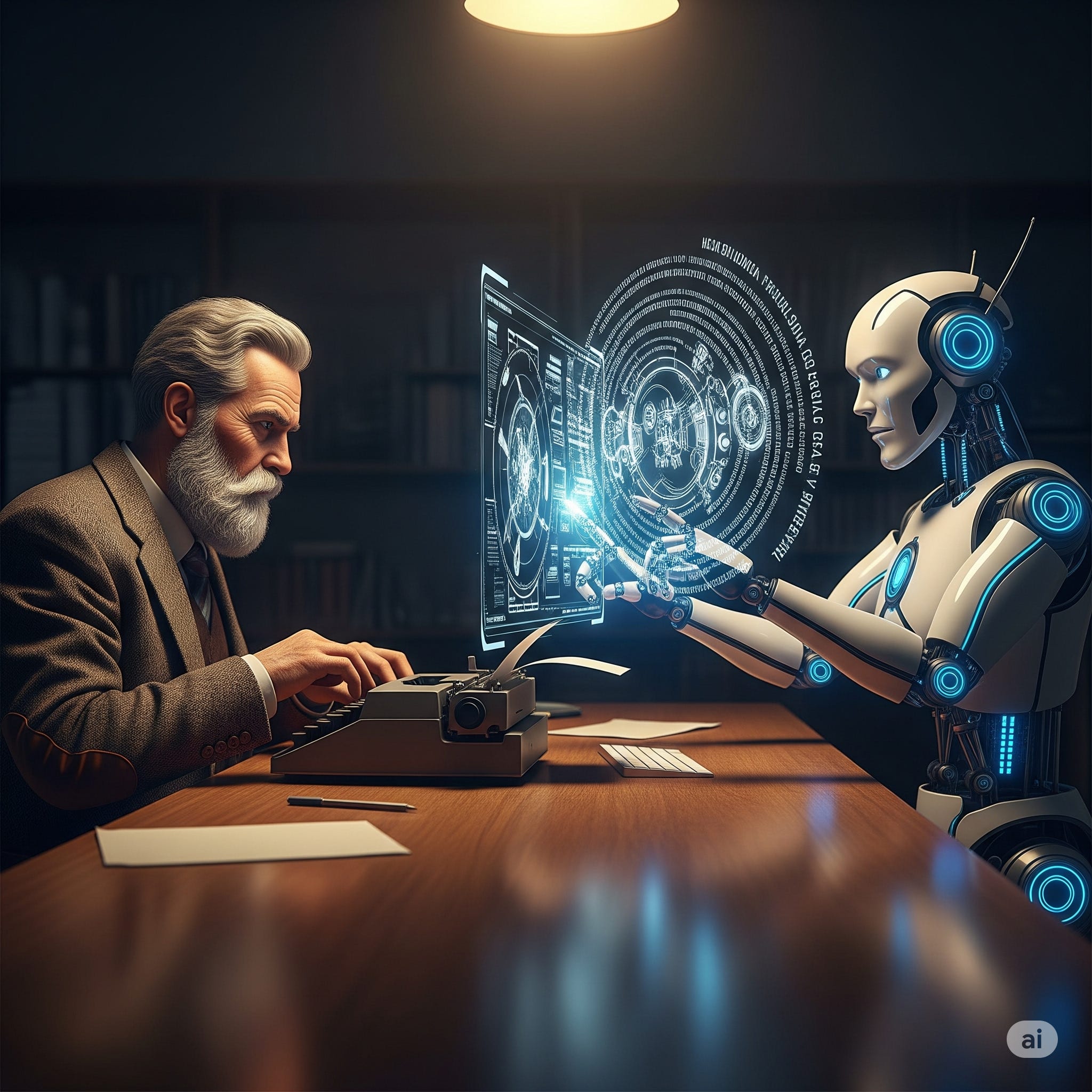
This editorial aims to demystify that process, framing it through the lens of Systems Thinking – examining the Inputs, the Process (now heavily AI-augmented), and the Outputs. It also serves to introduce readers who may be new to these concepts to the capabilities of Large Language Models (LLMs) like Google's Gemini and specialized AI tools like NotebookLM, illustrating how they can serve as powerful co-pilots, enhancing our ability to communicate rapidly and, perhaps surprisingly, with a voice that remains authentically our own.
For clarity, Large Language Models (LLMs) are sophisticated AI programs trained on vast quantities of text and code. They learn intricate patterns, relationships, and structures within language, enabling them to understand natural language prompts, generate human-like text, summarize complex information, translate languages, write code, and much more. While they don't "understand" or "think" in a human sense, they are incredibly powerful pattern-matching and generation engines that can significantly augment human intellect and creativity.
II. The Inputs: The Genesis of an "Independent Variables" Piece
Every creative endeavor begins with inputs. In my AI-augmented workflow, these inputs are a blend of human intellect and technological capability:
The Human Element – The Core Intellectual Seed:
The Spark of an Idea: Each article begins with a core concept, an observation, a question, or a desire to explore a particular theme relevant to "Independent Variables" – often at the intersection of science, technology, systems thinking, education, and philosophy.
Decades of Experience & Foundational Models: My 30+ years in STEM research and education, along with established conceptual frameworks like my "Standard Systems Model" (with its E/M/I Trinity and 3-Tier Hierarchy of Complexity), serve as a deep well of background knowledge, context, and analytical lenses.
Narrative Arc & Core Message: Before engaging the AI, I typically have a desired narrative arc in mind – the story I want to tell, the argument I want to build, and the key takeaways for the reader.
"Notes to Self" (Now Prompts for AI): In my previous, solitary writing process, I would jot down notes on areas needing further research, concepts requiring clarification, or connections I wanted to explore. These now form the basis of my initial prompts to the AI.
The AI Toolset – The Technological Foundation:
Google Gemini (Pro Subscription): This serves as my primary "homebase" for ideation and drafting. Gemini is a family of multimodal LLMs from Google, capable of advanced reasoning across text, images, code, and more. The "Pro" version, available via subscription, offers enhanced capabilities. A key feature for my workflow is the ability to maintain pinned chats. Each major project, like "Independent Variables," has its own dedicated chat. This allows Gemini to "remember" the entire context of our previous conversations within that specific project, creating a persistent, evolving dialogue and a shared knowledge base for that topic. This is crucial for building upon earlier ideas without constantly re-explaining.
Imagen (Integrated within Gemini): For visual elements, Gemini provides access to Google's Imagen text-to-image generation models. This allows me to create custom images to accompany articles directly within my primary AI interface.
Google NotebookLM (Powered by Gemini Pro): This is a specialized AI research and writing assistant. Unlike general-purpose LLMs that draw from their vast pre-training data, NotebookLM is designed to be grounded in specific source documents that I upload. It can then summarize, answer questions about, and generate new content based exclusively on that uploaded material. This makes it exceptionally useful for tasks like creating an audio overview script derived directly from a published "Independent Variables" article, ensuring fidelity to the original text.
These human and technological inputs form the foundational layer of my content creation system.
III. The Process: A Human-AI Collaborative Workflow – System in Action
With the inputs defined, the process of creating an "Independent Variables" piece unfolds in several distinct, yet interconnected, phases, each characterized by a dynamic interplay between human direction and AI augmentation:
Phase 1: Article Conception and Drafting (Leveraging Gemini Pro in a Pinned Chat)
The Initial Prompt – Seeding the System: I begin by formulating a detailed prompt within the dedicated "Independent Variables" pinned chat. This prompt typically includes: the core topic, the desired narrative arc, key arguments to develop, specific concepts or "Systems Thoughts" to integrate, and those "notes to self" which now become explicit requests for Gemini to explore, explain, or provide background on.
AI as Research Assistant and First Drafter: Gemini processes this prompt, drawing upon its general knowledge base and, importantly, the context of our prior conversations within that pinned chat. It then generates an initial draft of the article directly onto its integrated "Canvas" document. This isn't merely a glorified autocomplete; it's a sophisticated generation of structured text, often incorporating background information I might have asked for, and attempting to follow the requested narrative.
Iterative Refinement – The Human-AI Feedback Loop: This is the most critical and interactive stage. I conduct a thorough, critical read of Gemini's draft. Then, through a series of further prompts, I guide revisions:
Clarifications & Expansions: "Please expand on this point," "Can you explain this concept more simply for a general audience?"
Tone & Voice Adjustments: "Make this section more reflective," "Adjust the tone to be more like an educational editorial."
Structural Changes: "Let's reorder these paragraphs," "Can we create a stronger concluding section?"
Integration of Specific Frameworks: "Please ensure this section clearly links back to the E/M/I Trinity." This iterative dialogue, much like working with a highly responsive human research assistant or co-writer, continues until the article meets my standards for clarity, depth, and alignment with the "Independent Variables" ethos. My agency and editorial judgment are paramount here; the AI proposes and refines, but the human directs and makes final decisions.
Phase 2: Visual Storytelling (Gemini with Imagen Integration)
Once the text is finalized, I often open a separate pinned Gemini chat dedicated to image generation.
I describe the desired visual metaphor or concept for the article, prompting for variations and refinements until an image is produced that I feel effectively complements the written piece.
Phase 3: Publication to Substack
The finalized article text and the generated image are then copied from Gemini's Canvas and the image chat, respectively, into my Substack editor for publication.
Phase 4: Generating the Audio Overview (Leveraging NotebookLM)
Grounding the AI: The published Substack article (as a PDF or text file) is uploaded as a source document into a dedicated NotebookLM "notebook" for "Independent Variables" podcasts. This crucial step ensures NotebookLM's responses and summaries are grounded exclusively in my actual published content.
Providing "Director's Notes": Using NotebookLM's "Customize" (or similar "Edit Instructions/Host persona") feature, I provide specific instructions to the AI "hosts" of the audio overview. These notes guide them on the desired story arc, key concepts to emphasize, the target audience (general, but intelligent), and any specific scientific or philosophical ideas that need careful explanation.
Length Selection and Generation: I select the desired length for the audio discussion (NotebookLM offers options like "shorter," "default," or "longer"). Remarkably, recent "longer" discussions have exceeded 40 minutes, offering a substantial and nuanced exploration of the article's themes, far beyond what I could script and record manually in a comparable timeframe. NotebookLM then processes the article and my instructions to generate a multi-voice audio .wav file.
Phase 5: Podcast Distribution
The .wav file from NotebookLM is uploaded to Substack to create a new podcast episode.
Substack then automatically distributes the podcast to linked platforms like YouTube Podcasts and Spotify.
IV. The Outputs: Enhanced Communication and a Consistent Voice
This AI-augmented, systems-based workflow yields several significant outputs and benefits:
Accelerated Cadence and Increased Depth: The most immediate output is a dramatic increase in publication frequency and often, the ability to explore topics with greater depth more quickly. The time-consuming aspects of initial research, drafting, and even creating supplementary audio content are significantly compressed.
Maintaining Authorial Voice and Style: A fascinating outcome, and one I've carefully monitored, is that the AI-assisted content sounds like me. After a year of using Gemini and NotebookLM, and having them analyze over a hundred of my previous editorials and publications (which I wrote "the long way"), the AI has become remarkably adept at mimicking my writing style, my mode of explanation, and even my tendency to weave in specific philosophical or systems-thinking frameworks. This is likely a result of:
Implicit Training: My extensive interaction and the grounding of NotebookLM in my own texts.
Explicit Guidance: My iterative prompting and detailed "director's notes" continuously steer the AI towards my preferred voice and structure.
Multi-Format Content and Expanded Reach: The ability to efficiently generate not only written articles with custom images but also substantial audio overviews allows "Independent Variables" to reach a broader audience through different mediums and platforms.
The Future Beckons: Personalized AI Voices: I fully anticipate that tools like NotebookLM will soon offer the capability to generate these audio overviews using an AI-cloned version of my own voice. This prospect – being able to share complex thoughts, perhaps even dictated from my phone while fishing, and have them transformed into polished articles and personalized audio podcasts – represents an almost unimaginable leap in communication efficiency for an independent creator.
V. Systems Thinking Reflections: The AI Co-Pilot in a Creative System
Viewing this workflow through the lens of Systems Thinking offers further clarity:
The Workflow as an Open, Adaptive System: It takes Inputs (ideas, my knowledge, AI capabilities), subjects them to a collaborative Process (prompting, AI generation, human refinement, AI audio synthesis), produces Outputs (articles, images, podcasts), and is subject to Feedback (reader comments, my own evaluation of the AI's performance, which informs future prompts and instructions). The system is Open to new ideas and new AI tool developments, and it is Adaptive as I refine my prompting strategies and as the AI models themselves evolve.
AI as a Powerful Leverage Point: The integration of Gemini and NotebookLM acts as a significant leverage point within my content creation system. Small inputs of human direction can yield large outputs of drafted content or synthesized audio, dramatically increasing the system's overall throughput and efficiency.
Human Agency Remains Central: Despite the sophisticated capabilities of the AI, human intentionality, critical judgment, and editorial control are the indispensable drivers of the system. The AI is a co-pilot, an amplifier, an accelerator – it responds to and executes instructions, but the vision, the core intellectual work, the ethical considerations, and the final approval remain firmly human. This aligns with the concept of Education as Agency – we are learning to wield these powerful new tools, to direct them purposefully, rather than being passively directed by them.
Interconnectedness of Tools and Processes: The workflow demonstrates how different AI tools and distinct human-led processes can be linked to form an integrated and more powerful content generation pipeline, from initial thought to multi-platform distribution.
VI. Conclusion: Embracing the AI Co-Pilot for a New Era of Intellectual Productivity
My journey into an AI-augmented workflow for "Independent Variables" has been one of discovery and significant productivity enhancement. By thoughtfully integrating tools like Google Gemini and NotebookLM as co-pilots in my creative process, I've found it possible to explore complex ideas more rapidly, produce content in multiple formats, and ultimately, share my "Systems Thoughts" with a wider audience, more frequently, while maintaining what I hope is a consistent and authentic authorial voice.
This is not about AI replacing human thought, but about AI amplifying it. It's about structuring a new kind of creative system where human insight directs artificial power. As these tools continue to evolve, the potential for individuals to research, synthesize, and communicate complex ideas will only grow. The key, as always in Systems Thinking, is to understand the components, their interactions, and to guide the system with clear purpose and critical agency. The future of independent thought and communication, augmented by thoughtful AI partnership, looks remarkably bright.
Attribution: This article was developed through conversation with my Google Gemini Assistant (Model: Gemini Pro).