
The Accidental Classroom
Unpacking the Profound Lessons in a Deck of Cards

We are often surrounded by objects so commonplace, so seemingly mundane, that we overlook their intricate histories and the deep design principles they embody. Recently, I found myself playing Klondike Solitaire with an actual, physical deck of cards – a tangible counterpoint to the digital versions many are familiar with. This simple act sparked a reflection: everyday items are frequently the result of centuries, even millennia, of development, iteration, and cultural fusion. A deck of playing cards, for instance, is not merely 52 pieces of pasteboard; it's a remarkably advanced system, a compact carrier of history, mathematics, and strategic thought, and an unintentional, yet surprisingly effective, teacher of important lessons. This is true not only for the physical deck but also for its digital incarnations, which have sometimes carried their own hidden pedagogical missions.
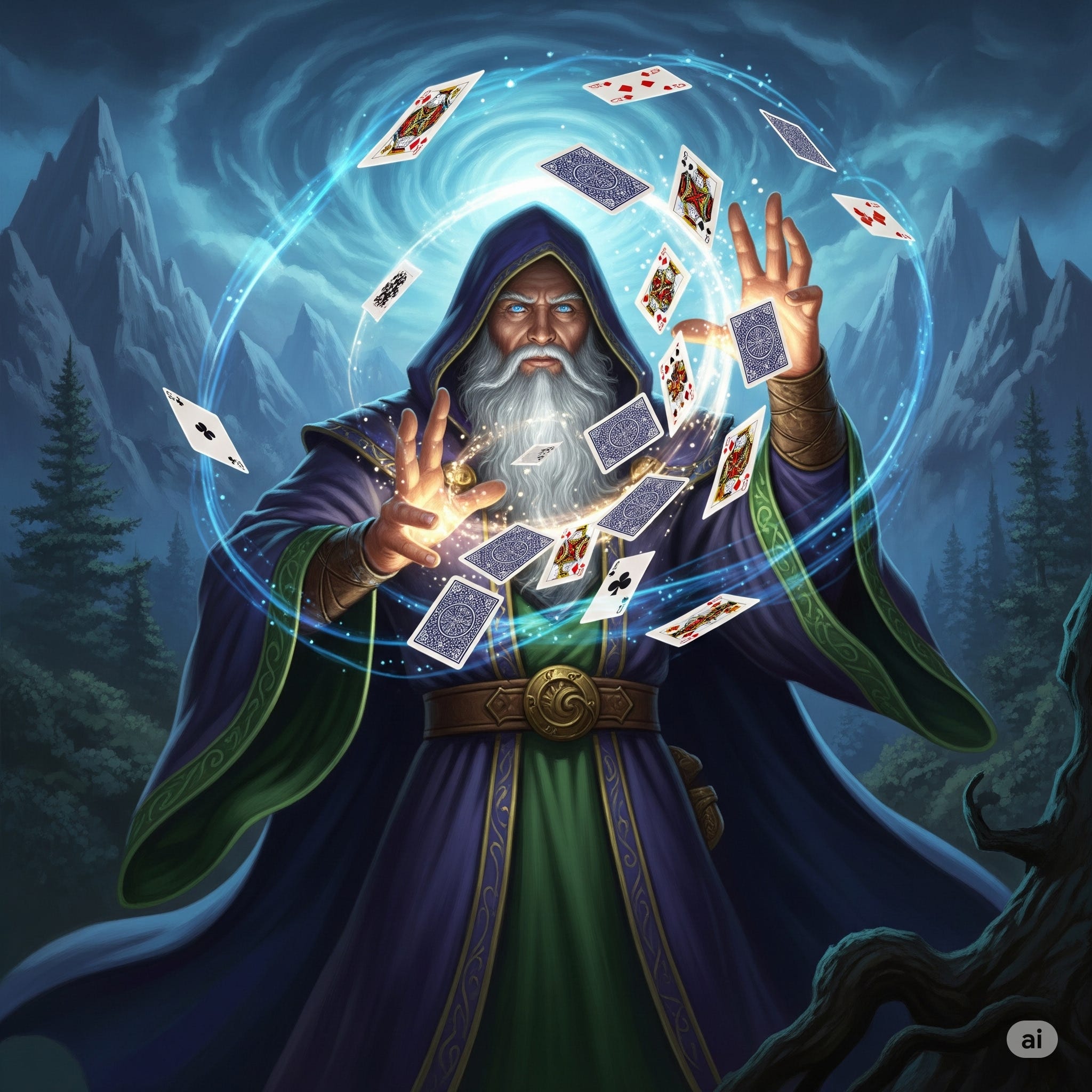
This exploration, prompted by that game of Solitaire and informed by an analysis of the structure and history of playing cards, seeks to reveal the deck as more than just a tool for games. It is a testament to human ingenuity, a system of interconnected patterns that has, for generations, subtly introduced us to concepts of number theory, counting systems, the significance of specific numerical patterns, and the art of strategic thinking. Its digital version even played a crucial role in onboarding a generation to a new paradigm of computing.
The Deck as a System: A Symphony of Numbers Teaching Foundational Concepts
The familiar 52-card deck is a marvel of numerical and symbolic organization. From a systems thinking perspective, it's a collection of distinct components (cards) with defined attributes (suit, rank) whose interactions (the rules of a game) lead to emergent behaviors and outcomes. At its heart lies a structure that almost seems designed to introduce fundamental mathematical and logical concepts:
The Power of Four (Suits): The division into four suits – Hearts (♥), Diamonds (♦), Spades (♠), and Clubs (♣) – immediately presents the concept of sets and categorization. This is a primary cognitive skill, allowing us to group like items and differentiate between groups. The distinction between red (Hearts, Diamonds) and black (Spades, Clubs) suits introduces binary classification, a foundational concept in logic and computer science. The number four itself is deeply resonant in human experience, historically linked to the seasons, cardinal directions, and classical elements (in some traditions like ancient Greece – Earth, Air, Fire, Water). For a child learning to sort, the four suits provide a tangible, visual way to engage with grouping and differentiation. This isn't just about recognizing shapes; it's about understanding attributes and relationships, a foundational skill for mathematics and all logical reasoning.
The Significance of Thirteen (Ranks): Each suit contains thirteen cards: Ace (A), numbered cards 2 through 10, and the face cards Jack (J), Queen (Q), and King (K). This introduces a base-13 system within each suit, a distinct counting system. Playing with these cards familiarizes one with sequences (e.g., 7, 8, 9), ordinal numbers (first card, second card in a sequence), and the concept of a numerical range with defined upper and lower bounds. Games quickly teach the hierarchical value within this range – that a '7' is quantitatively more than a '6' but less than an '8', and that J, Q, K themselves have a specific, often increasing, hierarchical order of power or value depending on the game. The number thirteen also carries historical echoes, notably its connection to the approximately 13 lunar cycles (lunations) in a solar year, a detail found in many ancient calendrical systems. This subtle link to celestial rhythms adds another layer to the deck's embedded information.
Fifty-Two and the Year (Total Cards): The product of 4 suits and 13 ranks (4 x 13) yields 52 cards. This number’s direct correspondence to the 52 weeks in a Gregorian calendar year is a striking piece of embedded information, subtly connecting the deck to larger cyclical systems that govern our lives. This offers an early, playful link between a game and the temporal structure of our world, a system we all inhabit.
The Sum of Values – A Calendrical Enigma?: A fascinating, though perhaps more coincidental than intentionally designed, piece of lore suggests that if one assigns numerical values to cards (Ace=1, 2=2, ..., Jack=11, Queen=12, King=13), the sum of all spots (pips) in the deck equals 364. Add one Joker (often seen as a "wild card" or representing a single unit) to bring this total to 365, the number of days in a standard year. The second Joker could then account for a leap year. While its historical veracity as an original design intent is debated by scholars, the mathematical property itself serves as a wonderful example of hidden numerical relationships. It can spark curiosity about combinatorics (the different ways cards can be arranged), number theory, and the surprising patterns that can emerge from simple rule sets. For a young mind, simply counting the pips, adding card values, or understanding the 4x13 multiplicative structure provides practical lessons in arithmetic (addition, multiplication) far more engaging and contextually rich than a dry worksheet.
The very act of playing simple card games – Go Fish (set collection), War (value comparison), Crazy Eights (pattern matching) – involves recognizing numbers, understanding sequences (straights in poker or rummy), identifying sets (pairs, three-of-a-kind), and even developing an intuitive grasp of elementary probability (What are the chances of drawing the card I need?). These are not explicit lessons delivered by a teacher, but rather concepts absorbed organically through the interactive process of play. The deck becomes an "accidental classroom" for foundational mathematical literacy and logical reasoning.
A Journey Through Time: The Evolution of an Everyday Marvel as a System Adapting to its Environment
The deck of cards isn't a static invention, frozen in time. It's a dynamic system that has evolved over centuries through cultural exchange, technological advancements, and the changing needs of its "environment" – the societies and players who use it. This journey offers a tangible lesson in history, design, and the diffusion of innovations:
Ancient Origins and Diffusion: Believed to have originated in China around the 9th century AD, possibly evolving from dominoes, money-suited cards, or paper-based divination tools, playing cards began a long journey westward. This initial form was itself a system designed for specific cultural practices.
Mamluk Influence and European Adaptation: Introduced to Europe (likely Italy or Spain first) in the late 14th century, primarily via trade with the Mamluk Sultanate of Egypt. Early European cards were often luxury items, meticulously hand-painted and accessible mainly to the wealthy. The Mamluk suits – cups, coins, swords, and polo-sticks – represented different societal strata or values. As cards spread across Europe, these suits began to transform, adapting to local cultures and, crucially, to emerging manufacturing capabilities.
The Impact of Printing Technology: The development of woodblock printing and later, more refined printing techniques, was a pivotal environmental pressure. The elaborate Mamluk designs were complex and expensive to reproduce. By the late 15th century, the simpler, more stylized French suits we use today – Coeurs (Hearts), Carreau (Diamonds, originally tiles/squares), Trefles (Clubs, literally clovers), and Piques (Spades, pikes/spearheads) – became dominant. Their streamlined design was far easier and cheaper to print, facilitating mass production and wider dissemination. This transition is a classic example of how a technological shift in the environment (the advent of efficient printing) can drive significant changes in the design and adoption of an artifact. The system (the deck of cards) adapted to become more "fit" for its new manufacturing environment.
Reflecting Societal Structures: The inclusion of court cards representing royalty (King, Queen, and Valet/Jack – the latter an attendant or knight) was an early and enduring feature. This made the card hierarchy instantly recognizable and relatable within the feudal and monarchical social structures of medieval and Renaissance Europe. The cards mirrored the societal system.
The Joker – A Later Innovation: The enigmatic Joker is a relatively recent addition, not part of the original European deck structure. It was introduced in the United States around the 1860s specifically for the game of Euchre, where it served as the highest-ranking trump card (the "Best Bower" or "Imperial Bower"). Its inclusion, typically as two extra cards, likely emerged from evolving game design needs (providing a limited number of powerful wild cards without completely unbalancing games), manufacturing convenience (filling out standard sheet sizes for printing), and eventual convention.
This historical journey embedded within the deck shows how a system (the playing card deck) evolves through interaction with its environment: cultural transmission, adaptation to new technologies, and the changing functional requirements (new games, new rules) of its users. It’s a miniature, tangible lesson in the principles of systemic adaptation and the diffusion of innovations.
Klondike Solitaire: A System of Strategy, Patience, and Hidden Pedagogy
The game of Klondike Solitaire, likely named and popularized during the Klondike Gold Rush in the Yukon Territory of Canada in the late 1890s (prospectors with ample downtime needed simple, engaging pastimes), leverages the deck's numerical foundation to create a compelling intellectual challenge. Its specific rules further enhance the "teaching" potential, sometimes in unexpected ways:
The Significance of Seven Tableau Piles: The use of seven piles is not arbitrary. The number seven holds rich cultural and mystical significance across many traditions (seven days of creation, seven days of the week, seven classical planets, seven deadly sins, seven virtues, "lucky seven," etc.). Its use in Solitaire might tap into this innate human sense of completeness or a structured cycle. From a mathematical perspective, the very setup of the Klondike tableau embodies a fascinating numerical pattern: the cards are dealt into these seven piles in increasing sequence – the first pile gets one card, the second gets two, and so on, up to the seventh pile which receives seven cards. The total number of cards dealt into this initial triangular arrangement is the sum of the first seven natural numbers: 1 + 2 + 3 + 4 + 5 + 6 + 7 = 28. This sum makes 28 the seventh triangular number. Triangular numbers (1, 3, 6, 10, 15, 21, 28, ...) are a sequence of numbers obtained by the continued summation of natural numbers, and they can be visualized as dots forming equilateral triangles. The choice of the seventh triangular number for the tableau is elegant from a game design perspective. It uses a significant portion of the deck (28 out of 52 cards) to create a balanced initial layout with a good distribution of face-up (the top card of each pile) and face-down cards. This offers both immediate play options and hidden challenges that unfold as the game progresses, creating a system with both known and unknown states. This specific structure implicitly introduces concepts of arithmetic series, triangular numbers, and combinatorial arrangements, all within the context of simply setting up the game. The seven piles provide enough complexity and columns for strategic card movement (building down in alternating colors) without making the board overly cluttered or, conversely, too simple. It’s a well-tuned system.
The "Draw Three, Play One" Mechanic: This rule, a hallmark of classic Klondike, significantly increases the game's difficulty and strategic depth compared to drawing one card at a time. It restricts information flow from the stock (the remaining cards), forcing players to plan more carefully as playable cards can be temporarily "trapped" beneath others in the waste pile. This mechanic subtly teaches resource management (the stock as a finite resource), probability (anticipating which cards might appear in the next draw of three), working memory (tracking cards seen in the waste pile), and strategic foresight (planning several moves ahead to free up a needed card).
The Unintentional Mouse Trainer – Microsoft's Solitaire: Beyond the inherent mathematical and strategic lessons, Klondike Solitaire played a surprisingly pivotal, if accidental, pedagogical role in the history of personal computing. When Microsoft launched Windows 3.0 in 1990, it faced a challenge: how to teach a generation of users, largely unfamiliar with graphical user interfaces (GUIs), the fundamental mouse operations of point, click, drag, and drop. These actions were alien to users accustomed to command-line interfaces. Microsoft's solution was ingenious: they bundled a free, digital version of Klondike Solitaire with the operating system.
The game, by its very nature, required players to constantly use these new mouse skills. To move a card from one tableau pile to another, or to the foundation, users had to point at it, click and hold the mouse button, drag the card across the screen, and then release the button (drop it). This wasn't presented as a "mouse training exercise"; it was a familiar, engaging game. Millions of users spent countless hours playing Solitaire, and in doing so, they were unconsciously and effortlessly mastering the core mechanics of the new Windows, Icons, Menus, and Pointers (WIMP) interface. Microsoft Solitaire was, in effect, one of the most successful stealth educational programs ever deployed. It provided a "safe" and motivating environment to practice skills that would become essential for all subsequent computer use. While users were focused on building sequences and clearing the tableau, they were also building muscle memory and cognitive familiarity with a revolutionary way of interacting with technology. And, as a byproduct, they were continually exposed to the numerical structures of the deck – the sequences, the suits, the counting – reinforcing those "accidental classroom" lessons in basic number theory.
Playing Klondike, whether physical or digital, is an exercise in pattern recognition, logical deduction, patience, and, as Microsoft discovered, a great way to learn new motor skills. It demonstrates how a simple set of components (the cards) and a few well-chosen rules can create a complex system with emergent challenges and rewards, teaching strategic thinking and even fundamental computer literacy without overt instruction.
Conclusion: The Unseen Depths and Hidden Curricula of the Mundane
The standard deck of playing cards, so familiar as to be almost invisible, is a profound example of a well-designed, multi-layered system. It’s a historical artifact carrying the echoes of ancient cultures and technological shifts. It's a mathematical construct, subtly embedding principles of number theory, sets, sequences, and probability. It's a remarkably versatile tool for intellectual engagement and strategic thinking. Its structure—four suits, thirteen ranks, fifty-two cards—forms an interconnected pattern that has captivated human ingenuity for centuries.
The enduring appeal of playing cards, and games like Klondike Solitaire, speaks to the power of their elegant design. They are a testament to how simple components, when thoughtfully organized, can create a rich field for strategy, learning, and entertainment. Even its digital adaptation served a crucial, if initially unheralded, role in teaching a generation the language of a new technological interface. As we navigate an increasingly complex world, there's immense value in recognizing the "advanced and important" lessons, the hidden curricula, often embedded within the seemingly mundane items and systems that surround us. They are quiet teachers, offering insights into numbers, history, systems, strategy, and even the very way we learn to interact with new worlds, all hidden within a simple shuffle or the click of a mouse.
Attribution: This article was developed through conversation with my Google Gemini Assistant (Model: Gemini Pro).