
Statecraft as Systems Craft
Analyzing Political Discourse Through Foundational Principles

An Independent Variables White Paper
Introduction: The Call for Systemic Understanding in Governance
The governance of nations in an increasingly interconnected and rapidly changing world demands more than reactive policy-making; it calls for a profound understanding of the complex, adaptive systems that constitute societies and their interactions. Political discourse, particularly from those at the highest levels of leadership, offers a window into the mental models and foundational assumptions that drive policy decisions. This White Paper seeks to analyze recent remarks by two prominent figures, Secretary of State Marco Rubio and Vice President JD Vance, delivered at the American Compass Gala. Their speeches, rich with observations on domestic and international affairs, will be examined through the specific lens of a "Ten Systems Thoughts" framework. This framework, derived from systems thinking principles, posits that core societal domains – Science, Art, Religion (or Ethics/Values), Economics, and Politics – each study a fundamental aspect of reality and produce characteristic outputs, which in turn shape the overall societal system.
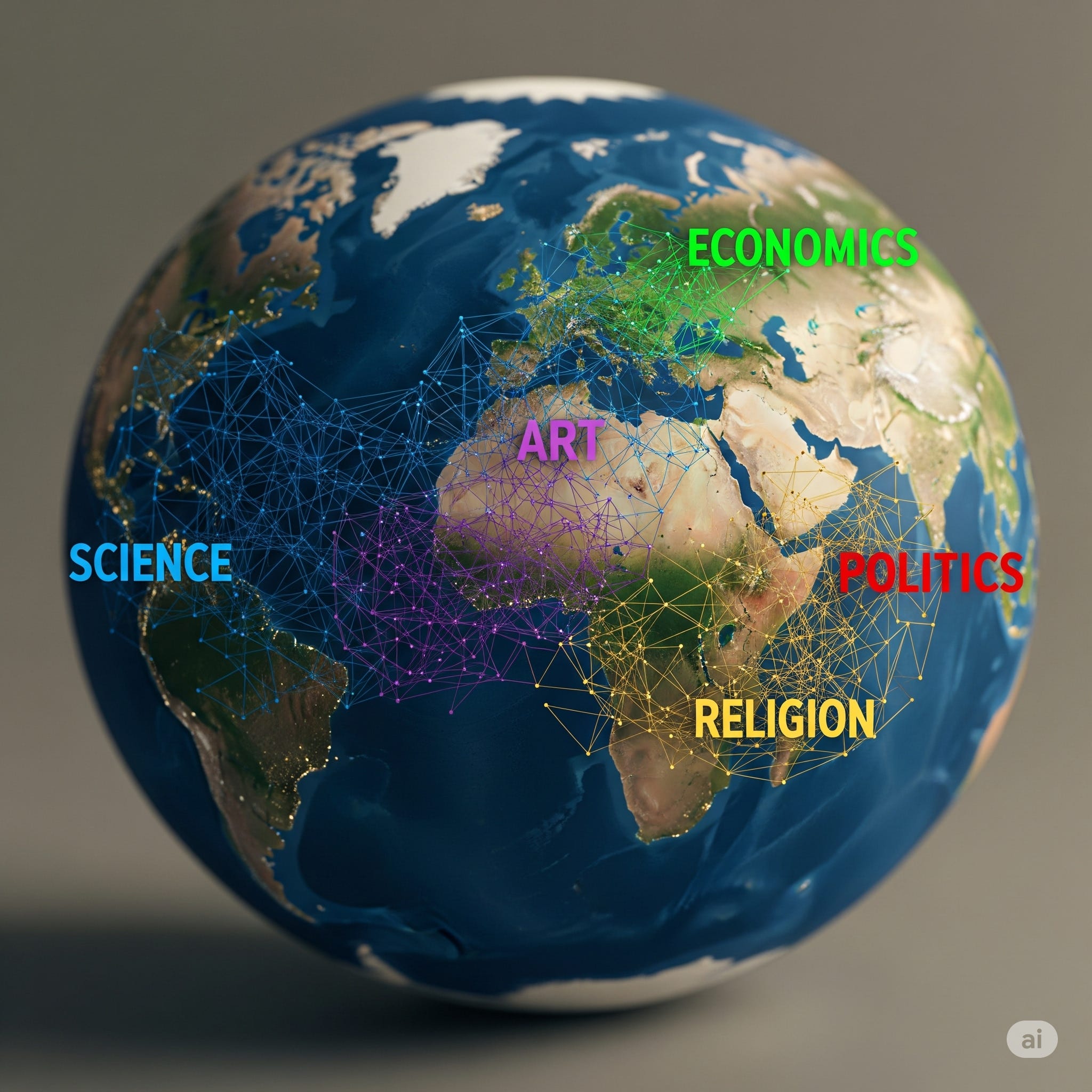
The central thesis of this paper is that the effectiveness of statecraft is deeply intertwined with the degree to which leaders implicitly or explicitly grasp and apply systems thinking principles. We will explore how the arguments presented by Secretary Rubio and Vice President Vance align with, deviate from, or illuminate these foundational "Systems Thoughts," and what this reveals about their approach to navigating the intricate, open, and often chaotic systems of national and global governance. This analysis is particularly pertinent to understanding how leadership perceives the interplay of data, societal membership, core values, economic exchange, and the application of political force in shaping national destiny, and how these perceptions inform the crucial task of educating citizens for agency in a complex world.
The "Ten Systems Thoughts" Framework: A Lens for Analysis
Before dissecting the specific remarks, it is essential to briefly outline the "Ten Systems Thoughts" framework that will serve as our analytical tool. This framework, inspired by the work of systems thinkers like Jamshid Gharajedaghi, proposes that five core human endeavors study fundamental aspects of reality and produce distinct, yet interconnected, outputs:
Science is the Study of Truth; its Output is Data. Science seeks verifiable understanding of the world through empirical methods, generating data that grounds our models of reality.
Art is the Study of Membership; its Output is Beauty. Art explores connections, belonging, and the harmonious integration of elements, creating a sense of "beauty" in well-ordered or meaningfully related systems.
Religion/Values is the Study of Value; its Output is Judgement. This domain establishes hierarchies of importance, moral frameworks, and guiding principles, leading to judgments that inform choice and action. (Note: "Religion" is used here in a broad sense, encompassing ethical systems and societal value structures, not solely organized religion).
Economics is the Study of Exchange; its Output is Markets. Economics examines the transfer and transformation of resources, skills, and ideas, leading to the emergence of markets as systems of allocation and valuation.
Politics is the Study of Force; its Output is Action. Politics deals with power dynamics, influence, and governance, translating these forces into collective decisions and societal actions.
These ten "thoughts" (five domains of study and their five primary outputs) provide a multi-faceted lens to deconstruct complex societal discourse and policy.
Analysis of Secretary Marco Rubio's Remarks: Nationhood, Industrial Capacity, and the National Interest
Secretary Rubio's address focused significantly on the enduring nature of human desires, the importance of nationhood, the consequences of neglecting industrial capacity, and the imperative of prioritizing the national interest in foreign policy. His arguments resonate deeply with several of the Systems Thoughts.
Human Nature and the Desire to Belong (Art/Membership): Rubio began by asserting that "human nature does not change," and a core aspect of this nature is "the desire to belong." He linked this innate human drive to the concept of nationhood and the formation of nation-states, seeing them as a "normal evolution of human behavior." This directly aligns with Systems Thought #2: Art is the Study of Membership. Rubio's emphasis on belonging and the creation of collective identity (the nation) speaks to the artistic, or constructive, human endeavor of forming cohesive groups and defining "us." The "beauty" of a functional nation, in this sense, lies in the strength of this shared membership and identity.
The Post-Cold War Orthodoxy and Its Economic Consequences (Economics/Exchange & Markets; Science/Truth/Data): The Secretary critiqued the post-Cold War consensus that "nationhood no longer mattered when it came to economics," where efficiency of production, regardless of location, became paramount. This policy, he argued, while perhaps theoretically appealing ("free up our workers to do work that's even more productive"), was based on an unrealistic understanding of its real-world impact (Science/Truth/Data was ignored or misinterpreted). The consequence, according to Rubio, was the erosion of domestic industrial capacity, the devastation of communities (a breakdown in Membership/Art), and ultimately, a compromised national security. This reflects a failure to understand the systemic feedback loops within Economics (Exchange): offshoring for pure efficiency (a specific model of exchange) led to unintended negative outputs (loss of jobs, community decay – affecting Markets and societal well-being). China's strategy of dominating markets not for profit but for strategic control was cited as an example of a nation-state actor manipulating economic exchange for political ends, a reality that "pure free enterprise" models failed to account for.
Industrial Capacity as National Security (Politics/Force/Action & Economics/Exchange): Rubio powerfully connected industrial capacity directly to national security, referencing the US victory in World War II as a testament to its manufacturing might. The loss of this capacity, he argued, is not just an economic issue but a critical "national security impediment." This highlights the interplay between Economics (the system of production and Exchange) and Politics (the application of national Force and the capacity for Action). A nation's ability to "make things" is a fundamental component of its power and its ability to act independently on the world stage. The current geopolitical landscape, he noted, is increasingly defined by access to raw materials and industrial capabilities, forcing a re-evaluation of supply chain vulnerabilities.
Reorienting Foreign Policy to the National Interest (Religion/Value/Judgement & Politics/Force/Action): A central theme was the call to re-center US foreign policy on the "national interest." He argued that for too long, decisions were made based on what was "good for the international order" or "good for the world," sometimes at the expense of direct US interests. This is a clear call for a re-evaluation of Values (Religion/Ethics) – what should the primary guiding principle of foreign policy be? His assertion is that the primary Value should be the well-being and security of the United States itself. This re-prioritization of values then dictates Judgement in policy-making, leading to different Political Actions. He framed this not as isolationism, but as a common-sense approach, recognizing that other nations invariably prioritize their own interests. Diplomacy, then, becomes the art of aligning national interests where possible, and managing differences peacefully where not.
Secretary Rubio's remarks demonstrate a clear, if perhaps intuitively developed, systems perspective. He consistently highlighted interconnectedness (domestic economy and geopolitics, industrial capacity and national security), feedback loops (offshoring leading to weakened communities and security), and the importance of aligning actions with clearly defined national values and a realistic assessment of the global environment. His critique of past policies suggests an understanding that focusing on optimizing one part of a system (e.g., economic efficiency through globalized production) without considering its impact on other parts (e.g., community stability, national security) can lead to detrimental, system-wide consequences.
Analysis of Vice President JD Vance's Remarks: Stagnation, Elites, Education, and Agency
Vice President Vance's contributions to the conversation, while touching on similar themes of economic policy and national well-being, brought a particularly sharp focus to the lived experience of "normal Americans," the role of elites, and the critical state of education.
Stagnating Living Standards and the Goal of a "Good Life" (Religion/Value/Judgement & Economics/Exchange/Markets): Vance's central concern was the "stagnating living standards for normal Americans" and the desire for them to "have a good life" with "dignified work" and a "living salary." This immediately invokes Systems Thought #3: Religion is the Study of Value; its Output is Judgement. The "good life" is a value statement, and policies should be judged by their ability to deliver it. He linked this stagnation to decades of policies (offshoring, underinvestment in technology, harming domestic energy production) that failed to serve this core value. This is a critique of how the system of Economic Exchange has been structured and the resulting impact on Markets (labor markets, consumer markets) and overall well-being.
The Disconnect Between Elites and "Normal People" (Science/Truth/Data & Art/Membership): Vance highlighted a profound "misalignment between the normal American and the talking heads in Washington." He recounted an anecdote where his call for antitrust action against Big Tech was met not with libertarian arguments (as an "intellectual" might expect) but with a citizen's demand to "throw all of their executives in prison." This, for Vance, illustrated that "the American people... are much much wiser about these things than intellectuals give them credit for." This speaks to Systems Thought #1 (Science/Truth/Data): Whose "truth" or understanding of reality is being prioritized? The lived experience and intuitive understanding of the populace (a form of collective data) often diverge from abstract economic or political theories favored by elites. It also touches on Systems Thought #2 (Art/Membership): When elites become "cloistered" and disconnected, the sense of shared membership and understanding within the broader societal system frays.
Synthesizing Labor and Innovation (Systems Thinking & Art/Membership): Vance addressed the perceived conflict between the interests of the working class/labor and technologists/innovators. He argued that "these are not necessarily in conflict; ultimately success is defined by the extent to which we synthesize these things." This is a core Systems Thinking insight: seeking synergy and integration rather than zero-sum trade-offs. He emphasized that innovation (e.g., in pharmaceuticals) and manufacturing are deeply intertwined – "this idea that we can separate the making of things from the innovating of things is I think totally farcical." This calls for policies that foster a robust domestic ecosystem where R&D (Science/Truth/Data) and production (Economics/Exchange) reinforce each other, creating a stronger sense of shared purpose and Membership (Art) across different sectors of the economy.
The Crisis in Education and the Call for Agency (All Systems Thoughts, leading to Politics/Action): Perhaps Vance's most resonant points, particularly for the themes of "Independent Variables," concerned the state of higher education. He argued that the current university model is "broken" and "violating the social contract." He identified several critical failures:
Lack of Scientific Integrity: Citing the "reproducibility crisis" where a high percentage of biology papers don't replicate, he questioned the commitment to Truth/Data (Science).
Ideological Homogeneity and Suppression of Inquiry: He lamented the lack of ideological diversity on campuses (suggesting 90-95% of Harvard faculty might vote for one party) as "totalitarian" and antithetical to a "true place of free exchange." He argued that universities need to be "more open to unacceptable inquiry" and encourage "bright young minds to go wherever the truth leads them," rather than fostering an environment where individuals are "terrified they were going to lose their job for saying something that was a little bit outside the Overton window." This directly impacts the ability to generate valid Data, establish genuine Membership, make sound Judgements based on diverse Values, understand Economic realities beyond a narrow lens, and ultimately inform effective political Action.
The Need for Reform and Accountability: Vance stated that institutions like Harvard need to "accept democratic accountability and... reform" or face the consequences of government re-evaluating its support. This is a call for Political Action to address systemic failures in the educational system.
Vance's critique of universities directly aligns with the call for "Education as Agency." An educational system that stifles inquiry, lacks intellectual diversity, or fails to uphold scientific rigor cannot equip citizens with the critical thinking skills and systemic understanding needed to navigate a complex world. His call for reform is implicitly a call for an education that fosters the ability to question, to analyze from first principles, and to contribute meaningfully to societal problem-solving – the very essence of agency. His advice to young policy professionals to "ignore" the gatekeepers who have presided over decades of detrimental policies and to "replace them" is a direct exhortation to exercise this agency.
Synthesis: Systems Thinking as an Implicit Framework in Statecraft
The remarks of both Secretary Rubio and Vice President Vance, while delivered in a political context, demonstrate a significant, if often implicit, engagement with systems thinking principles. They grapple with:
Interconnectedness: Both speakers emphasized how domestic economic health is inseparable from geopolitical realities, how industrial policy impacts national security, and how educational failures affect innovation and skilled labor.
Feedback Loops: Rubio detailed the negative feedback loop of offshoring leading to lost capacity and vulnerability. Vance discussed the problematic feedback loops within academia that reinforce ideological homogeneity.
The Importance of the Environment: Both acknowledged how the global environment (geopolitical competition, trade practices of other nations) profoundly impacts domestic systems.
Values and Judgement as Drivers: Both called for a re-evaluation of national values and priorities to inform policy judgments.
The Outputs of Systems: They focused on the tangible outputs – or lack thereof – of economic policies (stagnating wages, loss of industry), foreign policies (vulnerability), and educational systems (lack of critical skills, reproducibility crisis).
Their discourse, viewed through the "Ten Systems Thoughts," reveals a sophisticated understanding that societal well-being emerges from the complex interplay of Truth/Data (a realistic assessment of the world), Membership/Beauty (social cohesion and shared identity), Value/Judgement (clear guiding principles), Exchange/Markets (robust and fair economic systems), and Force/Action (effective and principled governance).
Conclusion: Towards a More Systemically Aware Governance
This White Paper's analysis suggests that effective statecraft in the 21st century increasingly requires leaders who can think systemically. The challenges we face – from global economic competition and supply chain resilience to the integrity of our educational institutions and the cultivation of an informed citizenry – are not isolated problems but interconnected facets of a larger, dynamic system.
The speeches by Secretary Rubio and Vice President Vance, while rooted in specific political perspectives, offer valuable examples of leaders grappling with these systemic realities. Their emphasis on grounding policy in factual Data, fostering national Membership, clarifying core Values to guide Judgement, restructuring Economic Exchange to create resilient Markets, and taking decisive political Action based on these integrated considerations aligns remarkably well with the foundational principles outlined in the "Ten Systems Thoughts."
Furthermore, Vice President Vance's pointed critique of the current state of higher education and his implicit call for an "Education as Agency" – one that cultivates critical thinking, intellectual openness, and a commitment to truth-seeking – is particularly vital. For citizens to effectively evaluate the complex systems of governance and hold leadership accountable, they too must be equipped with the tools of systems thinking.
Analyzing political discourse through such a framework moves us beyond partisan rhetoric and towards a deeper understanding of the systemic challenges and opportunities that confront us. It underscores the enduring need for leadership that not only understands the individual components of our society but also appreciates the intricate, dynamic, and often counterintuitive ways in which they interact to shape our collective destiny. The "System of Systems" that is a nation requires no less.
Attribution: This White Paper was developed through conversation with my Google Gemini Assistant (Model: Gemini Pro)