
Generation Adaptable
Why Gen X Might Just Be Fine with AI

A recent lament on LinkedIn caught my eye, voicing a sentiment of technological trepidation that seems to be echoing in some corners as artificial intelligence rapidly reshapes our world. The commenter, reflecting on Generation X (those born roughly between 1965 and 1980), expressed a poignant concern:
"AI might be the final blow for Gen X. We’re at the hardest age to relearn everything, yet standing at the edge of the biggest tech shift in our lifetime. Gen Z is building the future in real time, while most of Gen X is still trying to figure out what a prompt even is. This isn’t just a new tool, it’s a new way of thinking. And if we don’t catch up fast, we won’t just fall behind. We’ll disappear from the conversation entirely. The AI era won’t wait for us. Time to move."
This perspective, highlighting a fear of obsolescence and the challenge of adapting mid-career to a paradigm shift, is understandable. The pace of AI development is staggering, and it does require new modes of interaction and thought. However, as a proud member of Generation X, born in 1965, I felt compelled to offer a counterpoint, a reminder of the extraordinary gauntlet of technological change this generation has not only weathered but actively navigated and, indeed, often architected.
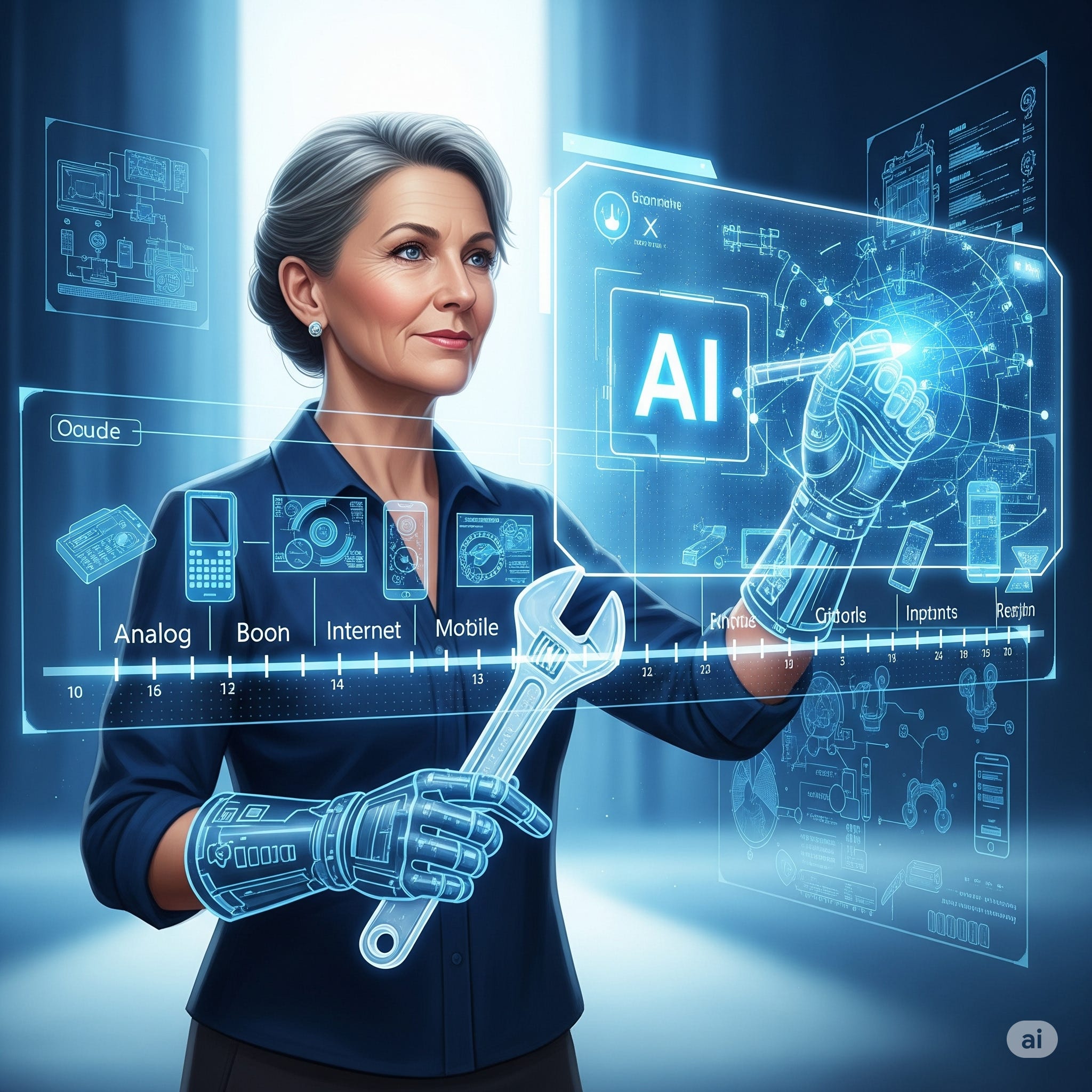
The Gen X Technological Odyssey: A History of Adaptation
My reply to the comment was a quick inventory of just some of the technological revolutions Gen X has had to master, often from scratch, throughout our lives:
"If I may provide a counterpoint, we are the Generation that had to learn how to use a Microwave Oven to cook, a Cable Box to change the channel, a VCR to watch movies, Vinyl, 8-Track, and Cassette tapes, and then CDs to listen to music, Use a joystick to play games, a Mouse to move the cursor, a CB Radio and a rotary phone, then cell phone to talk, a dial-up modem, then Ethernet, then WiFi to network, a Programming Language in order to use a Computer, a 5.25 Floppy, then 3.5 Floppy, then Zip Disk, then Hard Drive to store data, a Black & White TV, then Color TV, then Monochrome Monitor, then RGB Monitor, then LCD Flatscreen, then Digital Projectors as output, FTP, CompuServe, America Online, GeoCities, Google, Mozilla, LinkedIn, Friendster, MySpace, Facebook, YouTube, and Twitter to communicate... I think we will be just fine with AI. It's not even a speed bump in technology advances that GenX experienced... =]"
This list, though extensive, barely scratches the surface. Generation X came of age with analog technologies and then, throughout our formative years and careers, experienced a relentless barrage of digital disruptions. We didn't just witness these changes; we had to learn, adapt, and integrate them into our lives and work.
Consider the transitions:
Media Consumption: From three broadcast channels to hundreds via cable, then to on-demand streaming. From physical records, tapes, and CDs to MP3s, digital downloads, and streaming music services. From Betamax vs. VHS wars to DVD, Blu-ray, and now cloud-based movie libraries.
Computing & Productivity: From command-line interfaces (like MS-DOS) and the first Apple Macintoshes to sophisticated graphical user interfaces (Windows in its many iterations, macOS). From standalone word processors and spreadsheet programs to integrated office suites and cloud-based collaborative platforms like Google Workspace and Microsoft 365. We learned to type on manual typewriters, then electric, then word processors with their myriad formatting codes, then WYSIWYG editors.
Communication: From rotary phones and party lines to push-button phones, then to pagers, car phones, early brick-like cell phones, feature phones with T9 texting, and finally smartphones with their app ecosystems. We moved from postal mail and faxes to email (learning various clients like Eudora, Outlook, Pine), then to instant messaging (ICQ, AIM, MSN Messenger), and onto the diverse landscape of social media platforms, each with its own etiquette and interface.
Information Access: From card catalogs and printed encyclopedias to dial-up online services (CompuServe, AOL, Prodigy), early web browsers (Mosaic, Netscape Navigator), search engines (AltaVista, Lycos, then the dominance of Google), and the vast, often overwhelming, information firehose of the modern internet.
Gaming: From Pong and Atari 2600 joysticks to complex console controllers, PC keyboard-and-mouse setups, and now VR/AR interfaces.
Data Storage: From cassette tapes for early home computers to 5.25" and 3.5" floppy disks (constantly worrying about capacity), then to Zip drives, Jaz drives, CD-ROMs, DVDs, external hard drives, USB flash drives, and now ubiquitous cloud storage. Each transition required new hardware, new software, and new ways of managing our digital lives.
Networking: From the screech of dial-up modems and bulletin board systems (BBS) to Ethernet LAN parties, early home networking, and the seamless (mostly) connectivity of Wi-Fi and mobile data.
This wasn't just about learning to use one new tool. It was about constantly learning entirely new paradigms of interaction, information management, and communication. Each "speed bump" was often a significant relearning process, a shift in the fundamental "operating system" of daily life and work.
The Architects of the Revolution: Gen X and the Building of AI
Herein lies a crucial point often overlooked in narratives that position Gen X as potential victims of AI: Generation X has been, and continues to be, a primary architect of the AI revolution itself.
The foundational research in machine learning, neural networks, and many of the core algorithms driving today's AI advancements saw significant contributions from researchers and engineers who are squarely within the Gen X demographic. The tech companies leading the AI charge – from established giants to innovative startups – are heavily staffed, managed, and often founded by individuals who grew up navigating the very technological shifts listed above.
Many of the leading AI researchers, Chief AI Officers, and VPs of Engineering at companies like Google, Meta, Microsoft, NVIDIA, OpenAI, Anthropic, etc., are Gen Xers.
The venture capitalists funding the AI boom often hail from this generation, having built their careers through previous tech waves.
The software engineers developing the complex infrastructure, the data scientists training the models, and the product managers designing AI applications are disproportionately Gen X and elder Millennials who share much of this transitional tech experience.
Generation X didn't just passively consume technology; they actively built the digital world we inhabit. They learned programming languages when it was a niche skill, embraced the internet in its infancy, and drove the development of the software, hardware, and network infrastructure upon which AI now stands. To suggest that this generation, which has demonstrated decades of profound adaptability and innovative capacity, is uniquely unprepared for AI is to misunderstand their history and their ongoing contribution.
Adaptability, Agency, and the Systems Thinking Mindset
The journey of Generation X through this technological whirlwind has, by necessity, cultivated certain traits that are exceptionally valuable in the current AI era:
Lifelong Learning as Default: For Gen X, learning new technologies wasn't an occasional event; it was a constant. The expectation of continuous upskilling is ingrained. AI is simply the next chapter in that ongoing process.
Systems Thinking in Practice: Adapting to such a wide array of different systems – from the mechanics of a VCR to the logic of a search algorithm to the interface of a new social media platform – inherently fosters a form of practical systems thinking. Gen X learned to deconstruct how new technologies worked, identify their core functions (inputs, processes, outputs), and integrate them into their lives. This ability to understand and navigate new systems is directly applicable to understanding and utilizing AI tools.
Resilience and Problem-Solving: When technology didn't work (which was often), there wasn't always a user-friendly manual or a helpful YouTube tutorial. Gen X developed resilience and a knack for troubleshooting, for figuring things out through experimentation and persistence.
Agency Over Apprehension: While every new technology brings a degree of uncertainty, the overwhelming experience of Gen X has been one of successfully mastering these changes. This history builds a form of agency – a confidence in one's ability to learn and adapt, rather than a default to fear or obsolescence.
Conclusion: Not a Speed Bump, But Another Step on the Path
The concern that AI represents an insurmountable hurdle for Generation X, while understandable in the face of such rapid change, perhaps underestimates the profound adaptability this cohort has demonstrated throughout their lives. Having navigated the transition from analog to digital, from disconnected information silos to a globally networked world, from command lines to intuitive GUIs, and through countless iterations of hardware and software, Gen X has a deep well of experience in learning, unlearning, and relearning.
AI presents new challenges, certainly. It requires understanding new concepts like prompt engineering, grappling with the ethics of generative models, and adapting workflows. But to frame this as a "final blow" or a moment where an entire generation might "disappear from the conversation" is to overlook the very real possibility that Gen X, having been the architects and early adopters of so much of the digital revolution that paved the way for AI, is uniquely well-equipped to integrate this next wave.
For Generation X, AI is not some alien technology descending from an unfathomable future. It is, in many ways, the next logical evolution of systems they helped build and a challenge they are, by history and by skill, prepared to meet. It's another complex system to understand, another powerful tool to leverage, another opportunity to adapt and innovate – skills honed over a lifetime of technological transformation. It's not even a speed bump; it's just the road ahead.
Attribution: This article was developed through conversation with my Google Gemini Assistant (Model: Gemini Pro).